
Immortal
The Immortal Realm defines cultivators who have escaped aging and natural death, achieving stable eternal existence under cosmic laws.
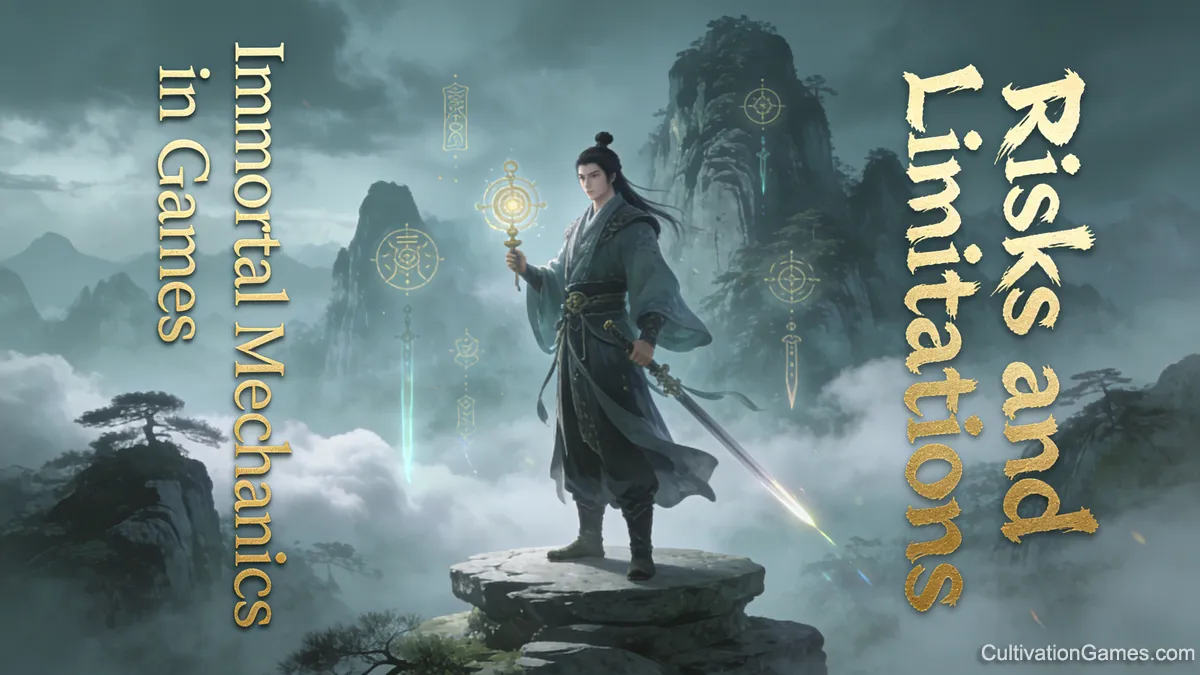
Realm Overview
The Immortal Realm represents the state in which a cultivator has fully escaped the limitations of mortality, time-based decay, and biological lifespan. Unlike Ascension, which focuses on leaving a lower system, Immortality is defined by existence stability rather than location.
In most cultivation frameworks, becoming Immortal does not imply invincibility. Instead, it signifies that death is no longer caused by aging, energy depletion, or natural entropy.
In Immortal Taoists, Immortality is treated as a persistent status effect where lifespan is removed from progression constraints, but combat risk remains.
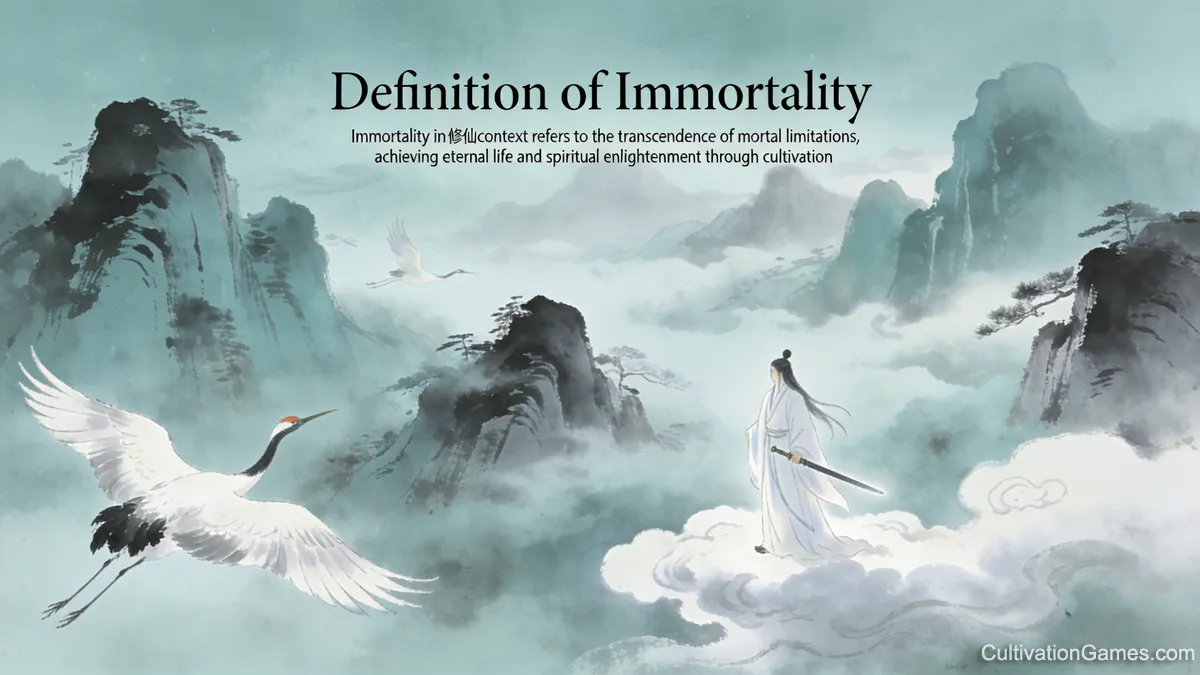
Definition of Immortality
| Aspect | Description |
|---|---|
| Lifespan | Unlimited |
| Aging | Ceased |
| Natural Death | Eliminated |
| External Death | Still Possible |
| Existence Anchor | Required |
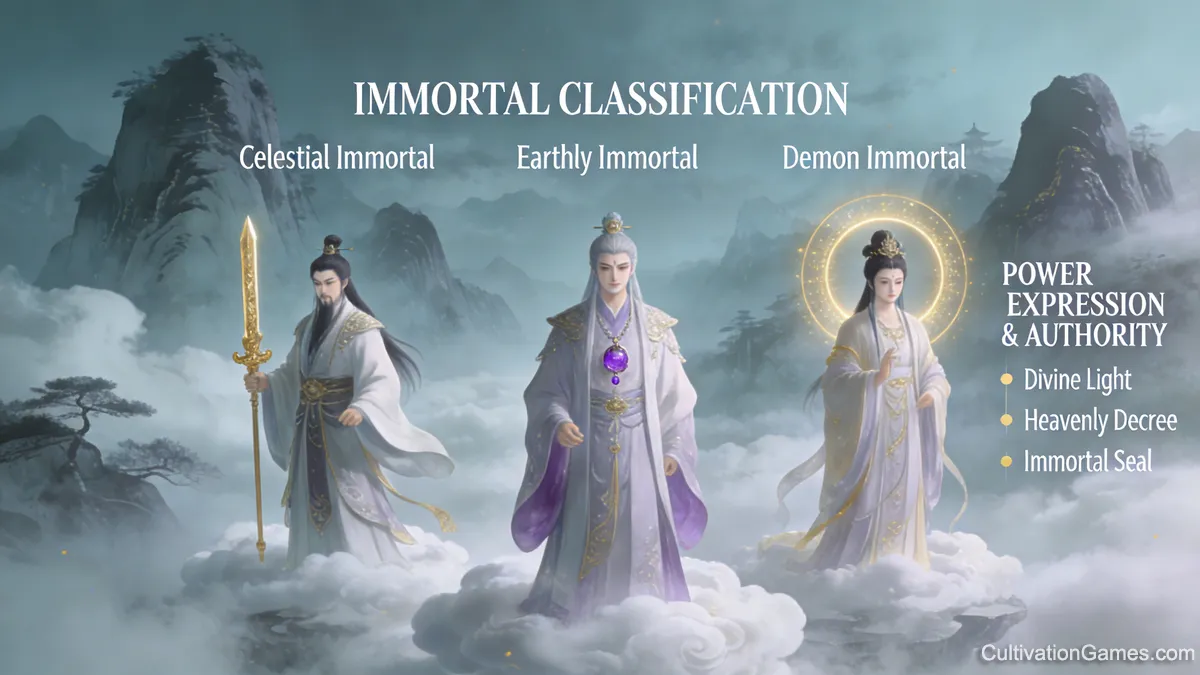
In A Record of a Mortal Journey to Immortality, immortals frequently perish due to conflict, emphasizing that immortality is not equivalent to safety.
Immortal Classification
| Immortal Type | Characteristics |
|---|---|
| Earth Immortal | Bound to world laws |
| Heaven Immortal | Governed by higher planes |
| True Immortal | Self-sustaining existence |
| Dao Immortal | Law-anchored being |
Some games simplify this into tiered immortal ranks, while narrative works often emphasize qualitative differences instead of linear power scaling.
Power Expression and Authority
Immortal power is rarely expressed through raw force. Instead, it manifests as law priority, domain persistence, and existence pressure.
| Attribute | Immortal Expression |
|---|---|
| Dao Authority | Persistent |
| Domain Stability | Permanent |
| Energy Loss | Negligible |
| Regeneration | Law-based |
| Suppression | Passive |
In Renegade Immortal, immortals are portrayed as entities whose presence alters the behavior of lower-realm cultivators without direct action.
Immortal Mechanics in Games
Different games represent immortality through mechanics rather than narrative labels.
| Game | Immortal Representation |
|---|---|
| Amazing Cultivation Simulator | Lifespan removal and law domains |
| Immortal Taoists | Eternal progression loop |
| Scroll of Taiwu | World-state influence |
| Tale of Immortal | Fate-locked survival |
These systems reinforce immortality as systemic permanence, not guaranteed dominance.
Risks and Limitations
Despite the name, immortals face unique risks.
| Risk Type | Outcome |
|---|---|
| Dao Collapse | Permanent annihilation |
| Domain Destruction | Severe weakening |
| Karma Accumulation | Targeted retribution |
| Law Conflict | Forced erasure |
Narrative settings often treat immortal death as final, with no reincarnation or retry mechanics.
Narrative and System Role
Immortals typically function as structural entities rather than protagonists. They stabilize worlds, enforce laws, or act as historical constants.
In Desolate Era, immortals are often background figures whose actions shape eras rather than stories.
💯Human Immortal Realm – Key Gameplay Focus
Most Important: Immortal foundation stability and resource efficiency.
Human Immortal is not about being powerful yet — it’s about learning how to exist as an Immortal. Players who treat this realm like a power spike usually fall behind quickly.
What Players Should Pay Attention To
Immortal energy efficiency (generation vs consumption)
Stability of Immortal body and soul
Long-term upkeep costs (cultivation, skills, equipment)
Whether mechanics now scale with Immortal realm level
This is where many games introduce maintenance systems that punish waste.
How Strong Players Pull Ahead
Using low-cost, high-efficiency Immortal techniques
Avoiding over-upgrading early Immortal gear
Focusing on stability and sustain over burst damage
Learning new Immortal-only mechanics before pushing realms
In games like Tale of Immortal, Human Immortal players who overextend often stall later.
Practical Outcome Difference
If done well:
Smooth progression with minimal resource drain
Flexibility to adapt to future Immortal paths
Stable foundation for higher Immortal realms
If done poorly:
Constant resource shortages
Forced grinding or stalled breakthroughs
Fragile builds that collapse under pressure
Human Immortal teaches one core lesson:
Immortal gameplay rewards control and patience, not aggression.
The Lowest Tier of Eternity: The Immortal Realm
Welcome to the Bottom of the Heavens: The Immortal Realm
The Immortal Realm marks ascension eligibility, not dominance, placing new immortals at the lowest tier of the celestial hierarchy.
The [Immortal Realm] represents the official boundary between mortal cultivation systems and the structured hierarchy of the heavens. Ascension does not signify dominance or divinity; it signifies eligibility. Upon entering this realm, a cultivator is formally recognized as a long-term entity permitted to exist beyond natural lifespan constraints.
Within higher planes, Immortals occupy the lowest functional tier. They are classified as celestial citizens rather than authorities.
Energy Conversion: From Spiritual Qi to Immortal Essence
Ascension requires complete replacement of mortal-grade Spiritual Qi with higher-density Immortal Essence.
The defining transformation of this realm is not raw power but energy quality. Mortal-grade Spiritual Qi is incompatible with celestial environments and must be fully replaced by Immortal Essence.
This conversion process is commonly referred to as the Celestial Baptism. During this phase, meridians, dantian structures, and circulation patterns undergo recalibration to withstand higher-density energy flows. Incomplete conversion results in structural instability, long-term cultivation stagnation, or regression.
New Immortals frequently experience extended periods of weakness due to energy mismatch rather than combat deficiency.
Immortality Without Invulnerability
Immortals are exempt from aging and biological decay, but they are not immune to destruction. Physical damage, law-based attacks, poison, and energy deprivation remain lethal.
Sustained existence requires access to Immortal-grade resources such as Immortal Stones, celestial veins, or sect-supported energy distributions. Without these, Immortals may experience essence depletion, resulting in power degradation or forced servitude within higher organizations.
Evolution of Perception
Upon ascension, Divine Sense undergoes qualitative expansion. Immortals perceive not only physical forms but also subtle fluctuations in space, energy density, and preliminary law traces.
This heightened perception creates a permanent gap between Immortals and mortals. Surprise attacks, concealment techniques, and conventional speed-based tactics lose effectiveness against ascended entities.
Providence as a Measurable Variable
Within the Immortal Realm, providence is treated as a functional resource rather than abstract fortune. High providence increases access to opportunities, inheritances, and survival margins, while low providence correlates with failed breakthroughs and environmental hostility.
Many cultivation systems incorporate providence accumulation, redistribution, or suppression mechanics to reflect this dynamic.
Ascended Immortals and Native Immortals
Celestial societies often distinguish between ascended Immortals originating from lower realms and native Immortals born within higher planes.
Ascended Immortals tend to possess stronger survival instincts, adaptive combat logic, and resilience developed through scarcity. Native Immortals frequently benefit from superior resources and institutional backing but may lack comparable experiential depth.
This division is a recurring narrative driver within celestial political conflicts.
Summary: Longevity Without Status
The Immortal Realm grants freedom from mortality but not freedom from hierarchy. It marks the beginning of true celestial competition rather than its conclusion.
Only through continued refinement, law comprehension, and essence stabilization may an Immortal advance toward True Immortal status and acquire genuine authority within the heavens.
Immortal FAQ
Is becoming an "Immortal" just about living forever?
At first, immortality sounds like the ultimate prize, right? But as seen in novels like A Will Eternal, the protagonist Bai Xiaochun soon realizes that immortality is just the beginning of a much greater challenge. In gameplay, your lifespan counter disappears, signaling that you've won the race against time. But don't get too comfortable. In the Immortal Realm, "death" doesn’t come from aging, but from other Immortals. You’ve traded the slow decay of time for the fast-paced dangers of celestial warfare. The real challenge? Staying relevant in a world where everyone has lived for millions of years. It’s no longer about survival—it’s about dominance.
Why do "Immortal Crystals" replace Spirit Stones as the primary currency?
Have you ever tried running a modern supercomputer on a battery meant for a TV remote? That’s what it feels like trying to use Mortal Spirit Qi to fuel Immortal Arts. Once you ascend, your body and meridians evolve to handle Immortal Essence. Mortal Spirit Stones become insignificant—essentially "pocket change." In games like Tale of Immortal, you'll start farming Immortal Crystals or Celestial Jade, materials infused with the fundamental laws of the universe. If you want to buy high-tier treasures or defensive arrays for your new immortal sanctum, you’d better start grinding in the higher-tier realms.
What is the "Immortal Physique" and how does it change combat?
Gone are the days of worrying about bleeding out or broken bones. With the Immortal Physique, the laws of your body are rewritten. In stories like Record of a Mortal's Journey to Immortality, an Immortal’s body can regenerate from a single drop of blood or even just a sliver of their soul. In combat, this means you’re no longer watching an HP bar—you’re dealing with Essence Regeneration. You become nearly impossible to kill using mundane weapons. To take down an Immortal, you need weapons capable of severing the soul or attacking the Laws that hold your body together. It's a massive upgrade to your character’s durability.
Does an Immortal still have to worry about the "Heavens"?
Don’t think the universe has forgotten about you just because you've ascended. Even as an Immortal, the Heavens are still keeping an eye on you. In many cultivation systems, Immortals face Celestial Tribulations every few thousand years—a cosmic "pruning" process that ensures only the strongest survive. The universe’s way of balancing the scales, if you’re not getting stronger, the next tribulation might be the one that turns you to ash. In games, this is often represented as a "soft cap" or a periodic challenge, pushing you to continuously upgrade your abilities and equipment. You’ve escaped the cycle of reincarnation, but now you're part of the "Great Dao"—and the Dao demands constant progress.
Common Names & Terms
Upon stepping beyond the mortal realm, you’ll encounter this stage referred to as the Immortal Realm, Ascended Being, Celestial Master, or Transcended Immortal. In games inspired by ancient Chinese mythology, terms like Xian or Shenxian are often used. This broad term refers to anyone who has successfully crossed the Heavenly Tribulation, traded their mortal lifespan for immortality, and secured a permanent place among the stars.
[Disclaimer: The following content is part of a cultivation game or fictional universe. It does not represent reality. All concepts are derived from xianxia novels and gaming mechanics.]
Author: cultivationgames · Chinese xianxia writer & cultivation game enthusiast
© Original content. Reproduction requires attribution. cultivationgames.com
What does Immortal mean in cultivation?
In cultivation systems, Immortal refers to a state where aging and natural death no longer apply.
Are immortals truly impossible to kill?
No. Immortals can still be killed through conflict, law destruction, or Dao collapse.How is immortality different from Ascension?
Ascension changes a cultivator’s system, while Immortality stabilizes existence itself.What risks do immortals still face?
Immortals face risks such as Dao collapse, domain destruction, and irreversible annihilation.Do immortals continue cultivating?
Yes. Most systems portray immortality as a foundation for further refinement rather than an endpoint.
Related Categories
- Explore more in "Cultivation Realm" VIEW ALL