
Mahayana
The Mahayana Realm (Dayan Jing) marks the stage where cultivators resonate with universal Dao laws. Learn its mechanics, risks, and depictions across games and novels.
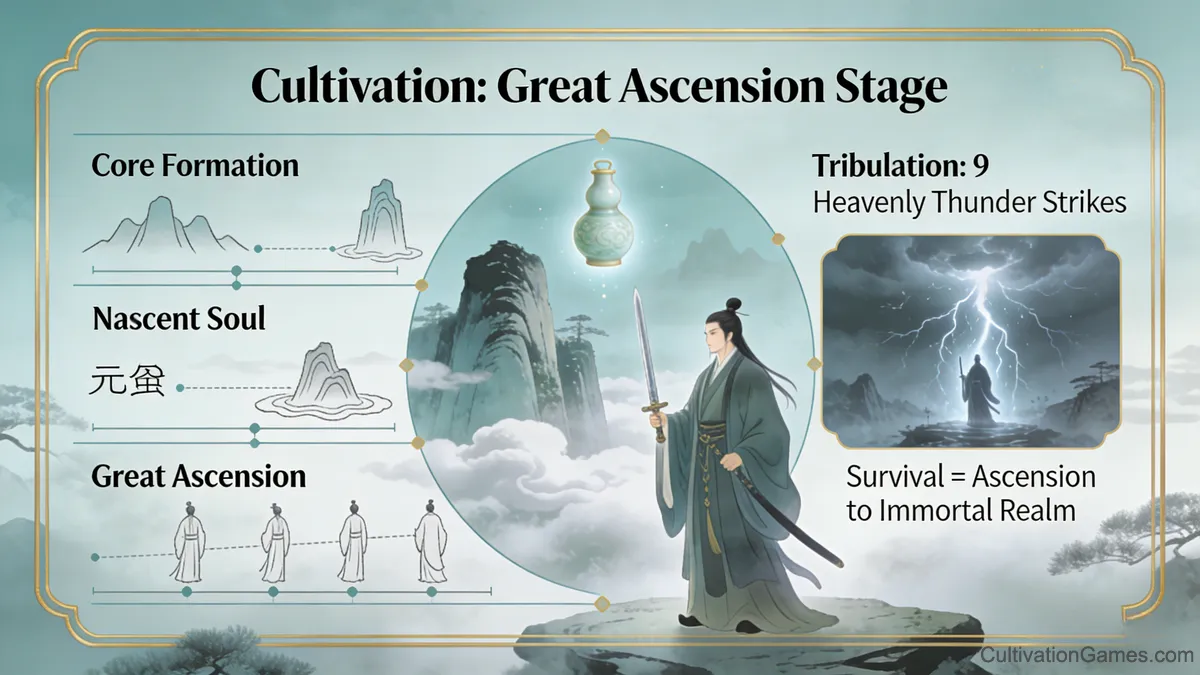
Realm Overview
The Mahayana Realm, also referred to as Dayan Jing, represents the stage where a cultivator transcends individual completeness and begins operating as a carrier of universal Dao principles.
Unlike earlier realms that emphasize internal perfection, Mahayana focuses on external resonance. Power at this level is no longer expressed through techniques alone but through alignment with larger cosmic structures.
In high-tier cultivation systems such as Renegade Immortal and simulation games like Amazing Cultivation Simulator, Mahayana marks the boundary where characters shift from personal advancement to environmental and law-level influence.
Common Alternate Names
| Term | Usage Context |
|---|---|
| Mahayana Realm | Standard English terminology |
| Dayan Jing | Pinyin-based systems |
| Greater Dao Realm | Narrative translations |
| Universal Law Stage | Game mechanics |
| Macro Dao Phase | Hybrid systems |
Core Realm Characteristics
The defining traits of the Mahayana Realm include:
- Dao influence extending beyond the physical body
- Automatic resonance with surrounding laws
- Reduced reliance on techniques and artifacts
- Existence defined by inevitability rather than action
In Immortal Taoists, this is the stage where passive Dao alignment replaces active cultivation loops, while in Desolate Era, Mahayana figures are described as existing within Dao flow rather than acting upon it.
Realm Status and Lifespan
| Aspect | Mahayana Standard |
|---|---|
| Existence Scope | Regional to planetary |
| Dao Authority | Near-complete |
| Physical Form | Optional |
| Lifespan | Effectively unlimited |
| Realm Suppression | Absolute |
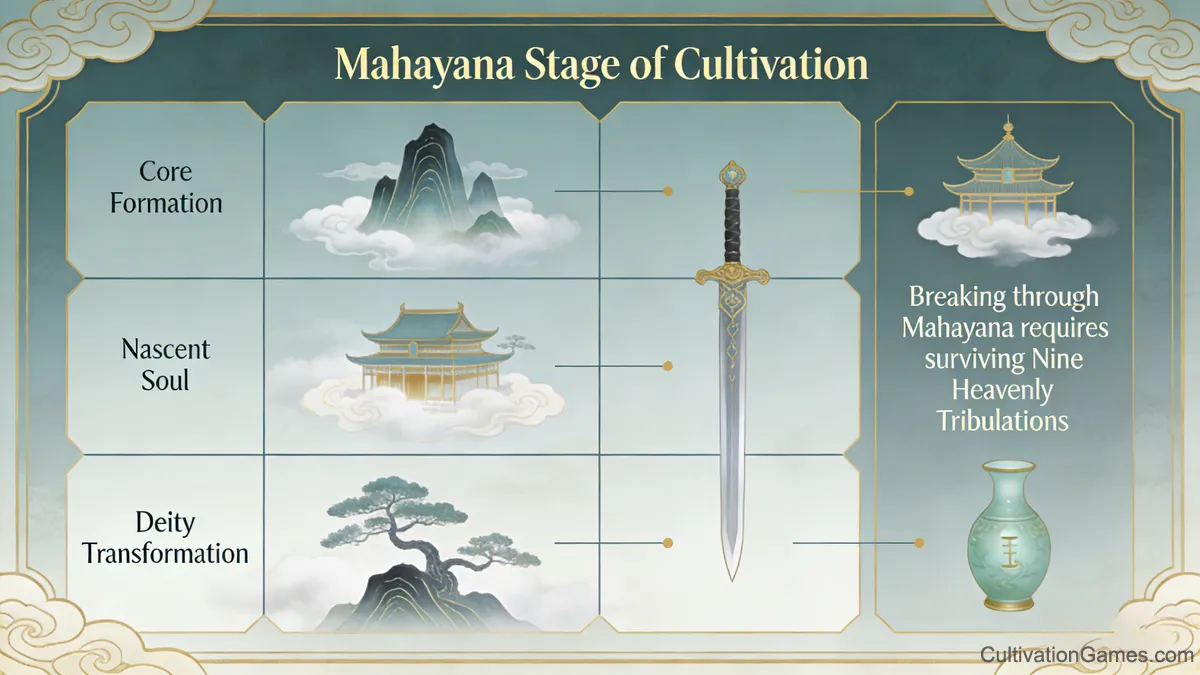
In A Record of a Mortal Journey to Immortality, Mahayana-level beings are portrayed as no longer bound by ordinary causality, with lifespan becoming irrelevant unless external laws intervene.
Attribute and Power Scaling
| Attribute | Typical Expression |
|---|---|
| Law Control | Domain-level |
| Domain Size | Continent-scale or higher |
| Energy Consumption | Passive resonance |
| Damage Mitigation | Law-based immunity |
| Soul Stability | Critical requirement |
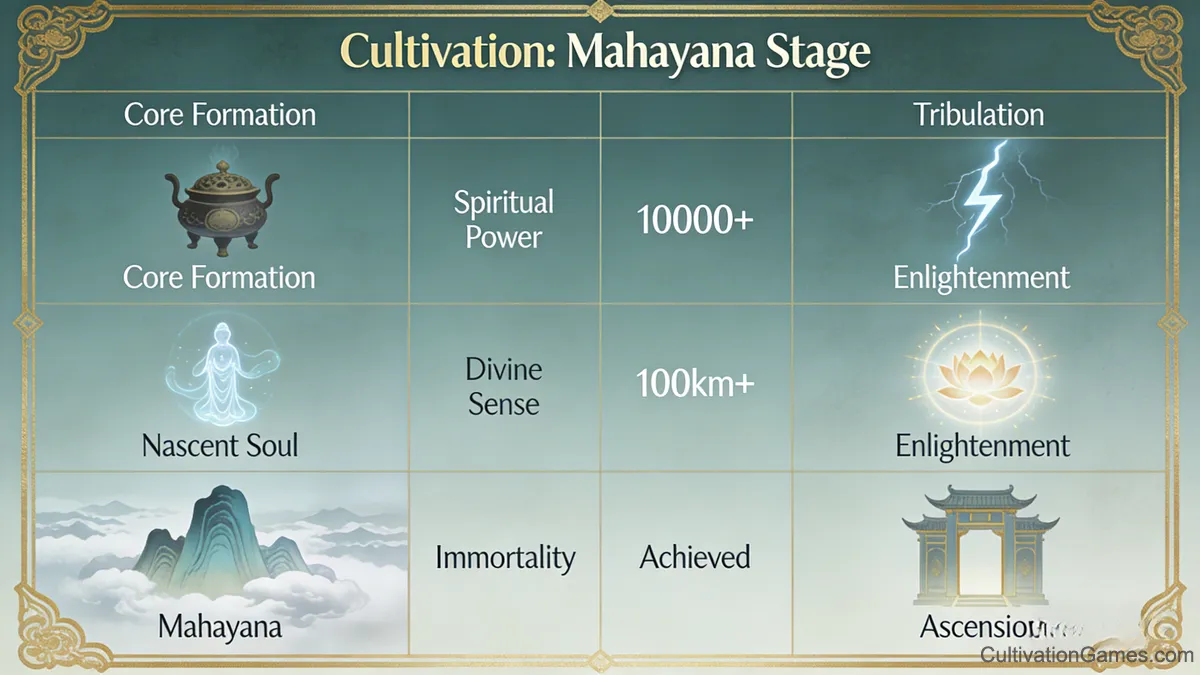
Games such as Amazing Cultivation Simulator implement this by allowing Mahayana characters to stabilize entire regions through Dao presence alone.
Cultivation Mechanics and Progression
Advancement into Mahayana generally requires:
| Requirement | Description |
|---|---|
| Perfect Body Integration | No internal conflict |
| Dao Completion | Stable law comprehension |
| Identity Anchor | Prevents Dao dissolution |
| Cosmic Compatibility | Resonance with universal patterns |
| Massive Resources | Supports expansion |
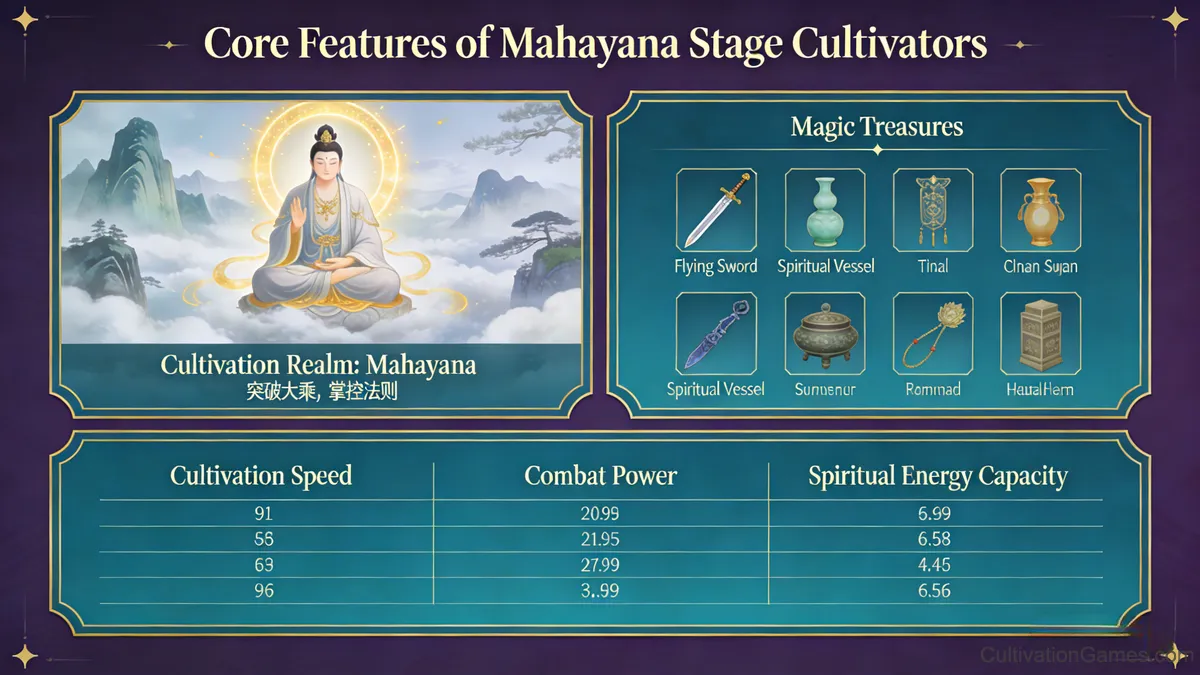
In Renegade Immortal, failure to stabilize identity at this stage often results in partial erasure or forced regression.
Risks and Failure States
| Failure Type | Consequence |
|---|---|
| Dao Dissolution | Loss of individuality |
| Resonance Collapse | Permanent regression |
| Identity Fragmentation | Unstable existence |
| Ascension Lock | Progress halted |
Several cultivation games treat Mahayana failure as an irreversible state, removing character agency entirely.
Fictional and Mechanical References
Across multiple systems, the Mahayana Realm is consistently portrayed as:
- A transition from self-focused cultivation to universal participation
- The final realm governed by structured mechanics
- A prerequisite for ascension or Transcendence
This interpretation appears in Immortal Taoists, Amazing Cultivation Simulator, Renegade Immortal, Desolate Era, and A Record of a Mortal Journey to Immortality, forming a shared genre standard.
💯Mahayana Realm – Key Gameplay Focus
Most Important: Law mastery depth and long-term scaling potential.
Mahayana is not about breaking through again — it’s about perfecting what you already chose. In most cultivation games, this is where builds stop being flexible and start being locked in.
What Players Should Pay Attention To
Whether your primary Law can scale into endgame
Law proficiency depth (tiers, layers, or mastery stages)
Synergy between Law, techniques, and equipment
Passive bonuses unlocked only at high Law mastery
At this stage, switching Laws is usually inefficient or outright impossible.
How Strong Players Pull Ahead
Focusing all resources into one dominant Law, not multiple average ones
Choosing Laws with proven late-game scaling (space, time, karma, destruction, life)
Unlocking Law passives that affect survivability, not just damage
Optimizing Law-trigger conditions (stacking, uptime, conversion rates)
In games like Amazing Cultivation Simulator or Tale of Immortal, Mahayana players with weaker stats but better Law scaling consistently outperform “wide builds”.
Practical Outcome Difference
If done well:
Skills gain exponential returns from Law bonuses
Endgame bosses become manageable through rule advantages
Build remains competitive deep into Immortal realms
If done poorly:
Damage and defense plateau early
Law bonuses stop scaling while enemies keep growing
Forced rebuilds or hard progression walls
Mahayana decides whether your build can survive the late game.
It’s the final checkpoint before Heavenly Tribulation filters out weak foundations.
Observations on the Mahayana Realm
Within xianxia cultivation systems, the Mahayana Realm (Da Cheng) is consistently portrayed as the absolute apex of mortal cultivation. It represents a state of complete internal perfection, where further advancement is no longer achieved through accumulation, but through readiness. Although Mahayana cultivators possess power comparable to gods, they remain classified as “mortal” because they have not yet crossed the boundary separating lower worlds from the Upper Realms.
Rather than emphasizing growth, this stage is typically depicted as one of stabilization, refinement, and acceptance. The cultivator must ensure that their existence is sufficiently complete and harmonious to be acknowledged by higher cosmic laws.
World Rejection and Existential Pressure
A defining feature of the Mahayana Realm is the phenomenon often described as world rejection. At this level, the cultivator’s presence alone may strain the spatial and energetic limits of a lower realm. Many narratives depict Mahayana experts as beings who must actively suppress their aura to avoid destabilizing their surroundings.
This concept serves both narrative and mechanical functions:
- The world can no longer naturally sustain their full power.
- Their mere existence may distort space, weather, or causality.
- Combat becomes rare, as conflicts risk catastrophic collateral damage.
As a result, Mahayana cultivators are frequently portrayed as deterrents or overseers rather than frontline combatants, embodying balance rather than domination.
Consummate Internal Perfection
By the Mahayana stage, the long-standing tension between body, soul, and cultivated essence has fully resolved. Unlike earlier realms that focus on fusion or reinforcement, Mahayana emphasizes harmony and completeness.
Common fictional standards include:
- Energy Refinement: Spiritual Qi is gradually transformed into Immortal Essence (Xian Qi), acclimating the cultivator to higher-realm energy.
- Stability Over Power: No major leaps in strength occur; instead, fluctuations and weaknesses are eliminated.
- Longevity Without Decay: Aging effectively ceases, though true immortality is not yet attained.
This phase is often framed as the final inspection before ascension.
Conceptual Authority and World Resonance
High-tier xianxia works frequently grant Mahayana cultivators limited conceptual authority. Rather than relying on techniques or spells, their will alone may influence reality.
Typical portrayals include:
- World Resonance: The environment responds naturally to their presence.
- Karmic Perception: Awareness of cause, effect, and long-term consequences.
- Lawful Expression: Actions align directly with natural or cosmic laws, bypassing conventional techniques.
This marks the transition from “power-based cultivation” to “existence-based authority.”
Final Mortal Attachments: Karma and Red Dust
Despite their perfection, many Mahayana cultivators remain unable to ascend due to unresolved karmic ties, often referred to as Red Dust. These attachments may include unfinished grudges, obligations, or emotional bonds.
Narratively, this stage often functions as:
- A period of reflection and closure.
- A return to earlier relationships or locations.
- The settling of long-standing cause-and-effect chains.
In games and structured systems, this is commonly represented as mandatory final questlines or purification trials preceding ascension.
Summary of the Mortal Apex
The Mahayana Realm represents the culmination of mortal cultivation. It is not a stage of ambition, but of readiness. A Mahayana cultivator no longer competes within the world; they stand above it, awaiting judgment by higher laws. Whether one lingers to protect a legacy or ascends immediately, the meaning of the realm remains consistent: this is the final moment of being human before stepping beyond humanity itself.
[Author's Note: In gameplay terms, Mahayana often functions as a completion phase. Progression shifts away from leveling and toward narrative resolution, preparation, and transition into higher-realm content.]
Mahayana FAQ
Is there actually anything left to do once you hit Mahayana?
Honestly? It’s a bit like hitting the level cap in a massive MMO. In stories like Record of a Mortal’s Journey to Immortality, this is when the protagonist Han Li spends his time tying up loose ends and preparing for the ultimate leap. In a game, you’re probably just optimizing your gear and tackling those "impossible" side quests. But don't get lazy! This is your final chance to polish your Dao Foundation. If you rush into the next world without perfecting your skills here, you’ll go from a "Big Fish in a Small Pond" to "Plankton in an Ocean." Most veteran players use this time to nurture disciples or leave behind a legacy—because once you leave, it’s not like you can return for your forgotten loot, right?
Why does the world seem to "reject" Mahayana cultivators?
Ever notice how the world around you seems to get… glitchy? In cultivation lore, your power has now grown so dense that the local space can hardly contain it. It’s like running a high-end graphics card from 2026 on a 1990s motherboard. You'll start to notice "Spatial Cracks" following you. If you unleash a full-power attack, you might accidentally erase a small kingdom or tear a rift in reality. This is why Mahayana masters often meditate in seclusion or hide in alternate dimensions. They’re not antisocial; they’re just trying not to break the planet with a sneeze. It’s a lonely peak, but the view? Incredible.
How does "Law Mastery" feel compared to lower stages?
Remember when fireballs seemed like the peak of power? At Mahayana, you don’t cast fire—you are fire. Your understanding of the Heavenly Laws is so profound that you can bend local physics to your will. Want it to rain upwards? Done. In combat-focused games, this means your attacks ignore nearly all defenses. You're not playing the same game as a Nascent Soul cultivator anymore. At this stage, it’s more like a creative mode simulator where your Intent defines reality itself. It’s the ultimate power trip—but it also comes with the realization that you’re gradually becoming less human and more… universal.
What’s the deal with "Spirit Qi Conversion"?
This is a major technical hurdle. To survive in the higher realms, you have to convert your Mortal Qi into Immortal Essence or True Spirit Qi. It's a long, arduous process. It’s like trying to change your car’s oil while driving at 200 mph. If you don’t convert enough energy before the final tribulation, you’ll either be too "heavy" to ascend or too "fragile" to survive the higher realm’s pressure. Most top-tier players focus entirely on this conversion in the late game, because True Spirit Qi hits much harder than even the densest mortal energy.
[Disclaimer: This content is derived from xianxia novels and cultivation game mechanics. It is intended purely for fictional world-building and reference.]
Author: cultivationgames · Chinese xianxia writer & cultivation game enthusiast
© Original content. Reproduction requires attribution. cultivationgames.com
What is the Mahayana Realm in cultivation systems?
The Mahayana Realm is a high-level cultivation stage focused on mastering universal principles rather than accumulating personal power. Practitioners influence reality through comprehension, laws, and large-scale effects.
Is Mahayana stronger than traditional cultivation realms?
Mahayana is not defined by raw strength. It surpasses earlier realms by enabling cultivators to affect environments, laws, and outcomes rather than relying on direct combat power.How is Mahayana different from earlier cultivation stages?
Earlier cultivation stages focus on energy accumulation and physical enhancement, while Mahayana emphasizes enlightenment, law comprehension, and indirect influence over reality.Does Mahayana appear in cultivation games?
Yes. Games like Amazing Cultivation Simulator and Tale of Immortal represent Mahayana-style progression through law manipulation, domain control, and systemic influence rather than stat-based combat.
Related Categories
- Explore more in "Cultivation Realm" VIEW ALL