
Mortal
The Mortal Realm (fanren) is the pre-cultivation stage where individuals possess no Qi or spiritual power. Learn its definition, lifespan limits, latent talent, and role in cultivation systems.
Common Terms & Names
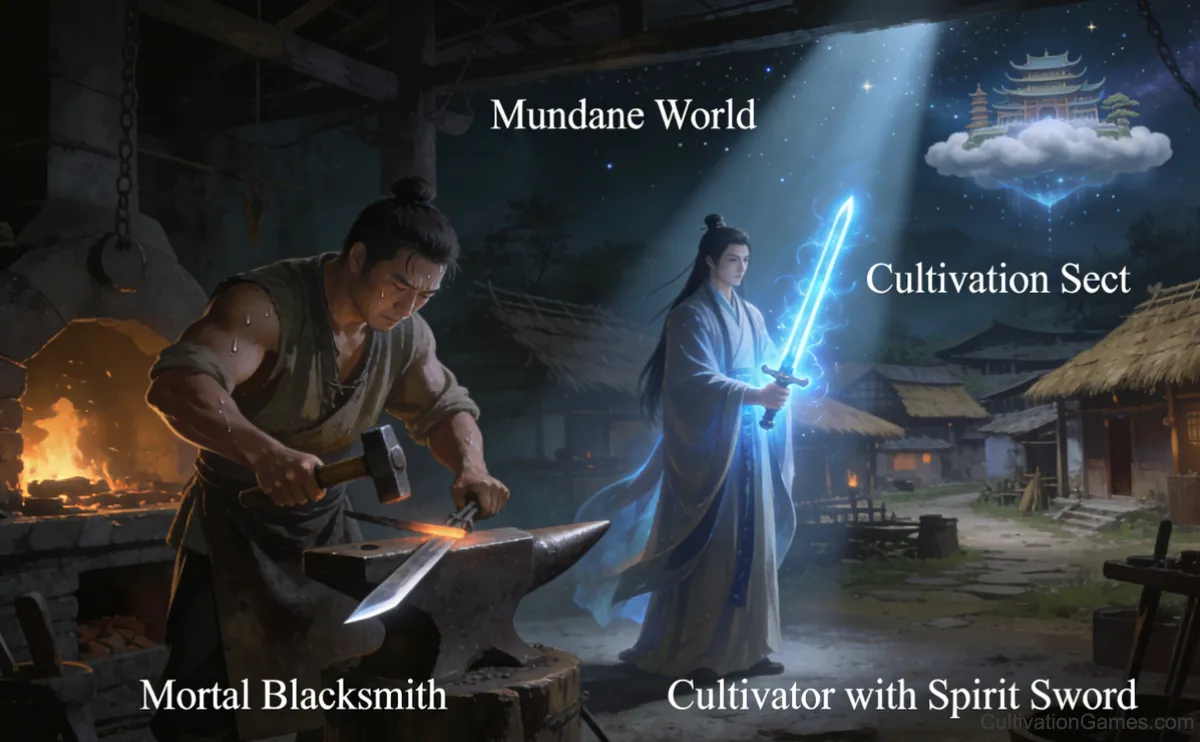
In the expansive lore of cultivation, this entry-level phase is often called the Mortal Realm, Ordinary Human Phase, Foundationless State, or simply Pre-Cultivation. In LitRPG settings, it's essentially Level 0. It represents the state of being a "base" human before the first thread of Qi enters your meridians.
Realm Overview
The Mortal Realm, commonly referred to as Fanren Jing, represents the baseline state of existence before an individual formally enters any cultivation system. Beings at this stage possess no active Qi circulation, no spiritual structure, and remain fully governed by natural physical laws.
In cultivation novels and games, the Mortal Realm defines the boundary between ordinary life and the cultivation path.
Core Definition
A mortal is any individual who has not initiated cultivation. This includes those who may possess latent talent, spiritual roots, or potential, but have not yet activated any cultivation mechanisms.
At this stage:
- Qi cannot be sensed or manipulated
- No cultivation techniques can be practiced
- No realm progression exists
- Power remains strictly non-supernatural
Realm Status Overview
| Attribute | Mortal Realm (Fanren Jing) |
|---|---|
| Qi Circulation | None |
| Dantian | Not formed |
| Meridians | Dormant or inactive |
| Cultivation Techniques | Unusable |
| Realm Classification | Pre-cultivation |
| Power Level | Ordinary human |
| Lifespan Extension | None |
Physical Limits and Lifespan
Mortals are entirely constrained by biological limitations. Strength, endurance, and durability do not exceed realistic human thresholds regardless of talent or lineage.
| Category | Typical Range |
|---|---|
| Average Lifespan | 60–90 years |
| Exceptional Longevity | 100–120 years |
| Aging | Irreversible |
| Injury Recovery | Mundane healing only |
Without external intervention, death is inevitable and permanent.
Talent and Spiritual Roots
Many systems introduce talent, aptitude, or spiritual roots at the Mortal Realm stage. However, these traits remain inactive until cultivation begins.
Key principles:
- Talent does not grant power at this stage
- Spiritual roots do not function without Qi circulation
- Mortals with high talent remain weaker than the weakest cultivator
Talent only determines future cultivation potential, not current capability.
Role of the Mortal Realm in Cultivation Systems
The Mortal Realm serves as the reference point for all subsequent realms. Its primary narrative and mechanical purposes include:
- Establishing the meaning of Transcendence
- Defining the cost of entering cultivation
- Emphasizing the gap between mortals and cultivators
- Creating irreversible transformation upon breakthrough
This realm ensures that cultivation is portrayed as a fundamental change of existence, not a simple skill acquisition.
Transition Out of the Mortal Realm
An individual exits the Mortal Realm only after successfully initiating cultivation, commonly through:
- First perception of Qi
- Activation of meridians or acupoints
- Entry into Qi Condensation or Body Refinement
- Adoption of a formal cultivation method
Once this threshold is crossed, the individual is no longer classified as a mortal.
💯Mortal Realm – Key Gameplay Focus
Most Important: Starting talent, base attributes, and irreversible traits.
The Mortal Realm is the only stage where rerolling and character setup truly matter. In most cultivation games, power differences do not exist here, but future potential does. Choices made during character creation permanently affect how fast, stable, and efficient cultivation will be later.
What Players Should Pay Attention To
Overall talent or aptitude rating
Core attributes such as constitution, perception, and intelligence
Rare or special traits that cannot be gained later
Hidden bonuses tied to background or origin choices
In games like Amazing Cultivation Simulator, these values directly affect cultivation speed, breakthrough success, and resistance to failure. Once the game begins, most of these traits cannot be improved in any meaningful way.
Practical Outcome Difference
If done well:
Faster progression in every future realm
Higher breakthrough success rates
Fewer wasted resources correcting early weaknesses
If done poorly:
Slower cultivation no matter how optimized later stages are
More frequent failures and bottlenecks
No reliable way to fully fix early mistakes
The Mortal Realm is not about power. It is about deciding whether the entire run starts with an advantage or a handicap.
Observations on the Mortal Stage in Cultivation Lore
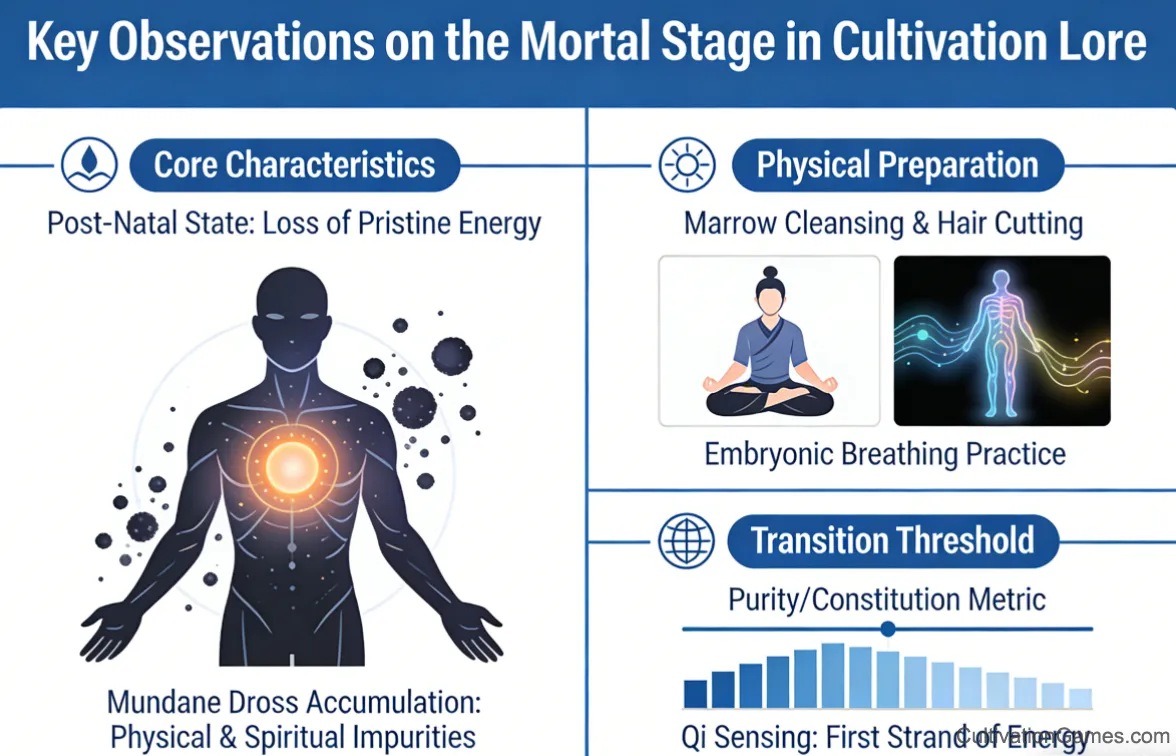
The Accumulation of Mundane Dross
In the logic of many xianxia games, the mortal body is constantly accumulating what is known as "dross" or "impurities." This isn't just a metaphor for toxins; it's often treated as a physical and spiritual sludge that clogs the meridians. In games like *Amazing Cultivation Simulator*, players often notice that characters who have lived longer as mortals are harder to "cleanse" because these impurities have settled deep into their bone marrow. The longer one stays in the mortal state, the more their internal pathways become opaque to the flow of worldly energy.
Novelists like Er Gen or Wang Yu often depict this through the lens of the five senses. A mortal sees the world through "dusty" eyes, meaning their perception is limited to the physical surface of things. They can't sense the spiritual veins in the earth or the ripples of energy in the air because their biological receptors are overwhelmed by the noise of survival—hunger, fatigue, and emotional fluctuations.
Patterns of Physical Preparation
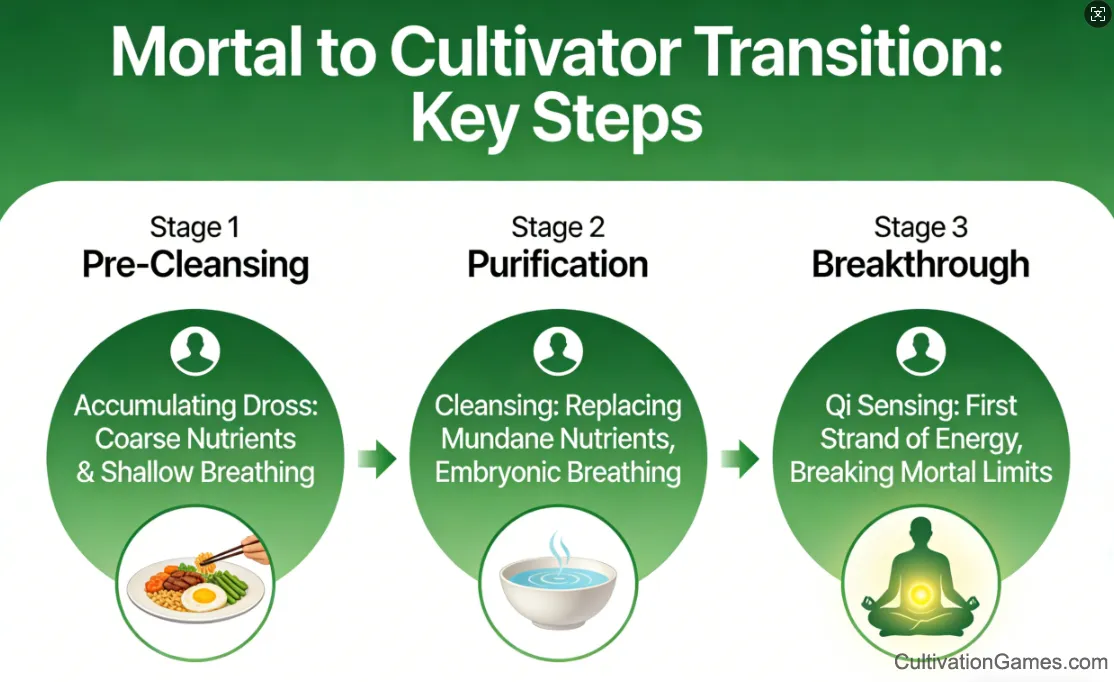
When looking at how characters move past this stage, there are several common threads. Most xianxia stories involve a period of "cleansing the marrow and cutting the hair." This isn't usually the actual breakthrough, but a necessary precursor. Games often implement this as a "fasting" mechanic or a "purification" quest. By consuming only dew or spirit grains, the character slowly replaces the coarse nutrients of the mundane world with something more refined.
In many settings, there's a subtle emphasis on the state of the breath. Mortals are said to breathe "shallowly," only using their lungs, whereas those preparing for the next stage begin to practice "embryonic breathing." This is a frequent trope where the character learns to mimic the way a fetus receives nourishment, bypassing the mouth and nose to absorb energy directly through the skin or the Dantian. It's an attempt to return to that pre-natal state before the world's impurities took hold.
The Threshold of Transition
The moment of leaving the Mortal Stage is often described with a sense of immense physical strain. Fiction generally portrays this as a "breaking through" of a literal barrier within the body. In *A Record of a Mortal's Journey to Immortality*, the transition is less about a sudden explosion of power and more about a slow, painstaking process of feeling the first strand of Qi. It's often described as a cold or hot thread moving through a needle-thin path in the body, which can be incredibly painful if the physical foundation hasn't been properly prepared.
Some game systems use a "Purity" or "Constitution" metric to determine success. If a character's physical body hasn't reached a certain level of refinement, attempting to sense Qi can result in internal damage. This reflects a common narrative rule: the transition from mortal to cultivator is a fundamental change in the state of one's existence. You are effectively moving from a system fueled by calories to a system fueled by the universe. If the "wiring" isn't ready for that change in voltage, the results are usually catastrophic in the story's lore.
It's often assumed in casual readings that being a mortal is simply "weakness," but many deep-lore novels suggest it's more of a "stagnation." The mortal body is designed for a short, intense burst of life—reproduction and survival—not for the long-term storage of high-density energy. This is why "Spirit Roots" are so valued in these stories; they act as a biological bridge that mortals otherwise lack. Without that specific organ or affinity, a mortal can try to refine their body forever and still never touch the Dao, because their hardware simply doesn't have the "port" for spiritual input.
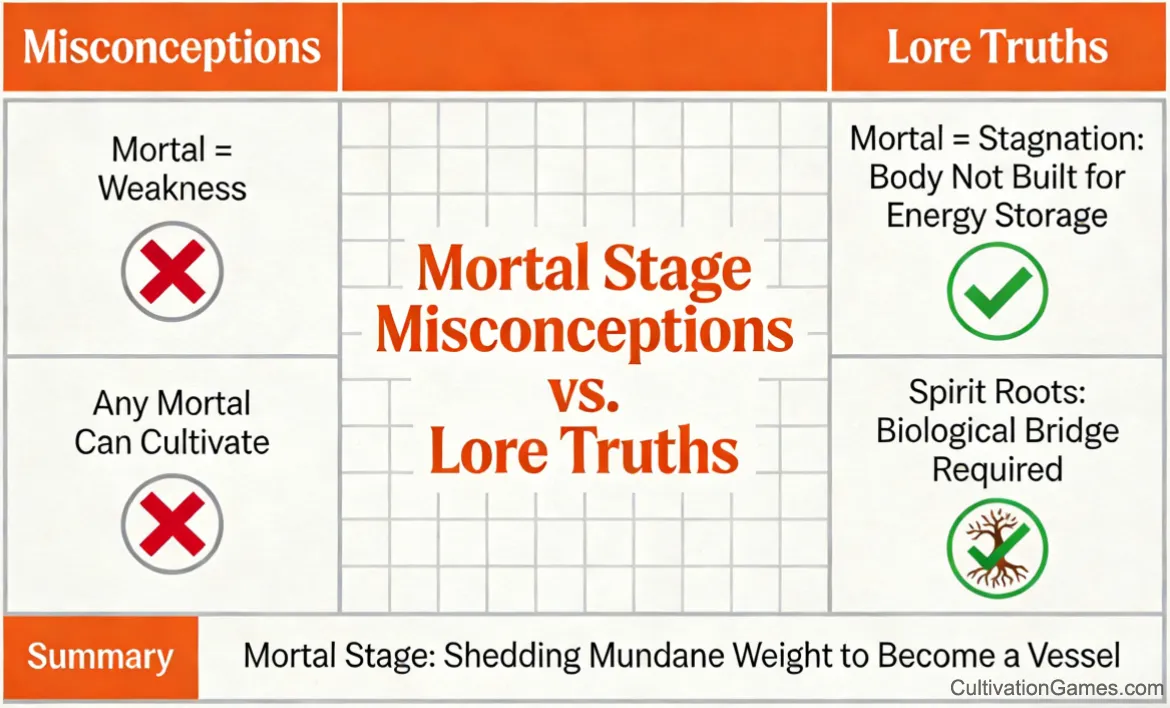
In gaming, this is often represented as a hard cap on stats. A mortal character might hit a ceiling in strength or agility that can only be broken by "Ascending" or "Breaking Through." This mechanical limit mirrors the literary idea that no matter how much a mortal trains in martial arts, they will eventually hit a wall that only spiritual intervention can overcome.
Summary of Observations
Across the genre, the Mortal Stage serves as a foil to the rest of the journey. It is the world of the mundane, the heavy, and the temporary. It’s where the stakes are the highest because death is permanent and the body is fragile. Whether it’s through the use of rare herbs, breathing techniques, or sheer discipline, the goal is always the same: to shed the biological weight of the world and become a vessel that can finally hold something more than just blood and bone. The focus isn't on what you gain, but on what you manage to leave behind.
[Author's Note: Within the context of most cultivation media, the Mortal Stage is the only time a character is truly tethered to the human experience. Once they move beyond it, they begin to lose their connection to things like regular food, sleep, and even mortal emotions, making this stage a crucial period for character development in xianxia storytelling.]
Mortal Stage FAQ
Is it possible to skip the Mortal Stage?
Most players and readers hope for a "Cheat" or a "Heavenly Pill" to skip the struggle, but honestly? It’s rare. Even a reincarnated Demon Venerable usually has to spend several chapters cleansing their mortal impurities. If you're playing a cultivation game, this is where your "Dao Heart" begins. Skipping it might save time, but you’ll miss the essential "Body Cleansing" that prevents your future Golden Core from being unstable. Don’t rush the foundation; even the tallest pagoda starts on solid ground, right?
Why do cultivators treat mortals like "ants"?
It sounds harsh, but it's a recurring theme in novels like Renegade Immortal. The gap isn't just about power; it's about the "Dimension of Life." When you can live for 500 years, a mortal’s 70-year lifespan looks like a summer breeze. Cultivators stop seeing mortals as peers because they lack the "Spiritual Roots" to perceive the world's laws. It’s not always about malice; sometimes, it's just the cold reality of a being that can level a mountain looking at someone who struggles to plow a field.
What are the hard limits of a Mortal's physical power?
You’re bound by the laws of biology. No matter how many push-ups you do, you can’t fly or breathe underwater without Qi. In terms of combat, a mortal is limited to mundane martial arts. You can be the "World's Best Swordsman," but the moment a Qi Condensation cultivator flies ten meters into the air and drops a fireball, the fight is over. It’s the stage of "Hard Work" before you unlock "Supernatural Powers."
Can a mortal ever defeat a cultivator?
We’ve all seen the stories where a clever mortal uses poison, traps, or massive "Ballistae" to take down a low-level cultivator. It’s possible, but only if the cultivator is incredibly arrogant and lacks "Divine Sense." Once a cultivator unlocks the ability to scan their surroundings with their mind, traps become useless. So, while it makes for a great underdog story, don’t bet your spirit stones on the mortal in a fair fight.
[Disclaimer: This content is derived from xianxia literature and gaming mechanics. It is for entertainment and world-building reference only.]
Author: cultivationgames · Chinese xianxia writer & cultivation game enthusiast
© Original content. Reproduction requires attribution. cultivationgames.com
What is the Mortal Realm in cultivation?
The Mortal Realm is the pre-cultivation stage where individuals have no Qi, no spiritual power, and no cultivation system, living entirely under natural physical and lifespan limits.
Can mortals use Qi or cultivation techniques?
No. Mortals cannot sense, absorb, or refine Qi. Cultivation techniques only function after successfully entering a formal cultivation realm.Does talent matter in the Mortal Realm?
Talent has no immediate effect in the Mortal Realm. It only determines future cultivation potential after cultivation begins.
How does one leave the Mortal Realm?
A mortal leaves the Mortal Realm by successfully initiating cultivation, typically through sensing Qi, activating meridians, or beginning Qi Condensation or Body Refinement.
Related Categories
- Explore more in "Cultivation Realm" VIEW ALL