The Nascent Soul Realm (Yuanying Jing) is where a cultivator forms an independent soul body. Learn its mechanics, abilities, risks, and depiction across cultivation games and novels.
Common Names & Terms
This stage is considered the pinnacle of early cultivation. It’s often referred to as the Nascent Soul, Origin Core, or Soul Birth. In older translations, it may appear as the Primordial Spirit phase. Whatever term you use, it's the moment your Golden Core evolves into a mini version of you, sitting comfortably in your Dantian, ready to hatch into full power.
Realm Overview
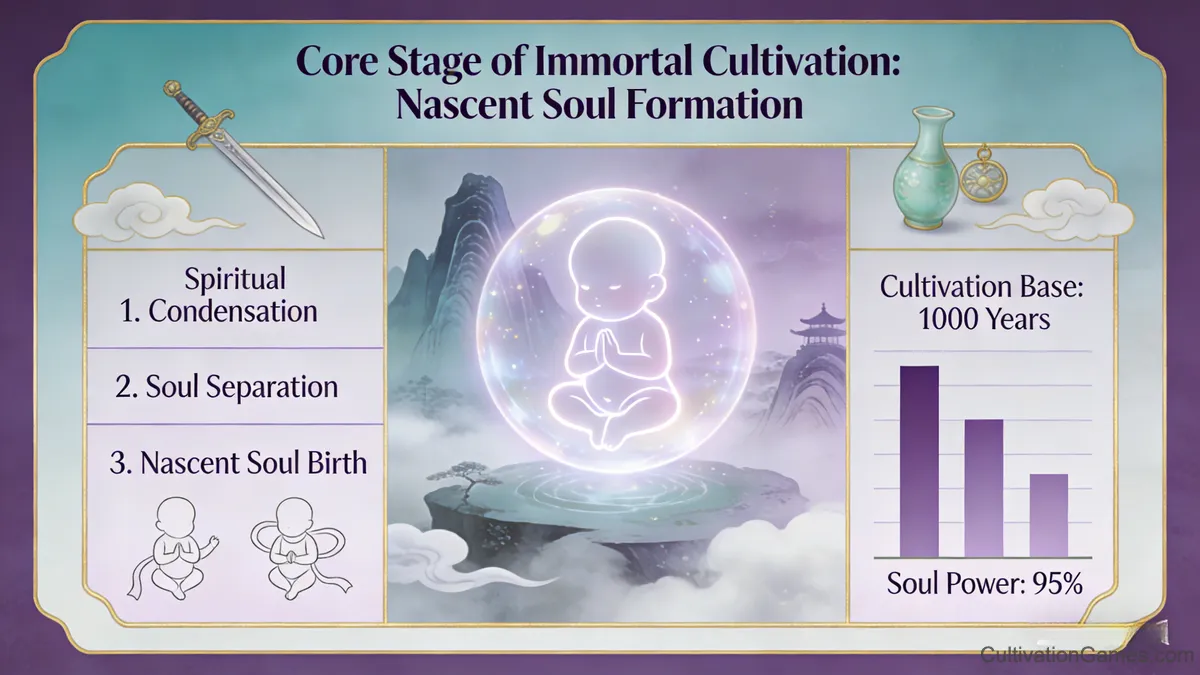
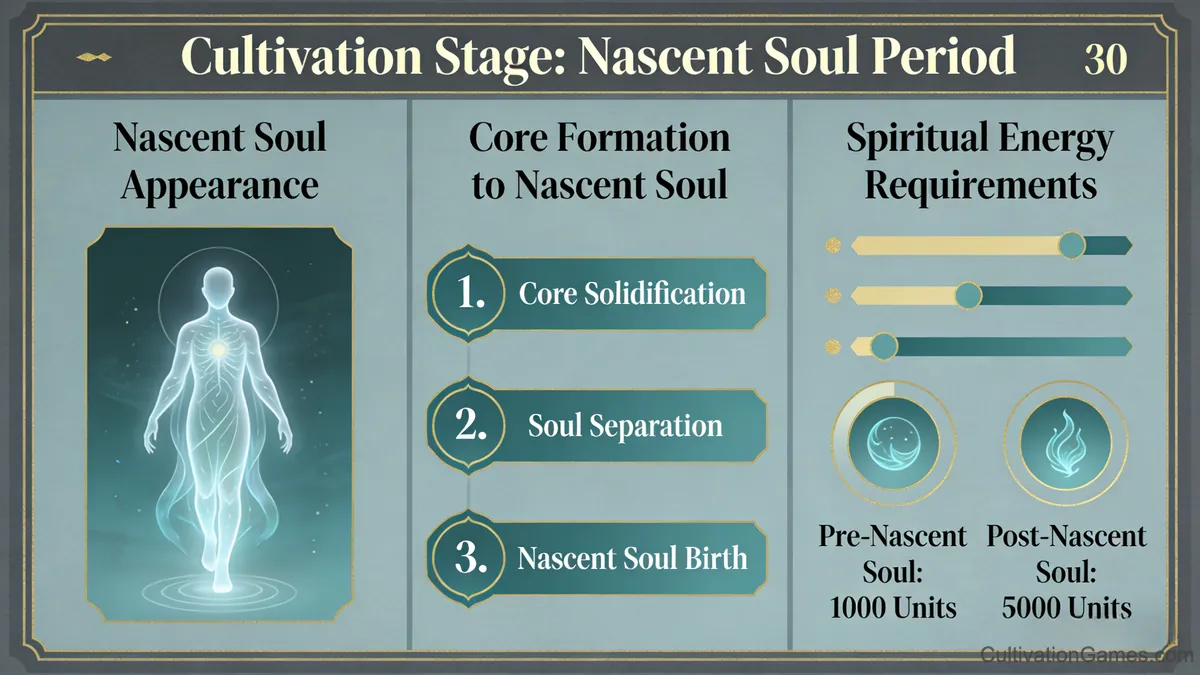
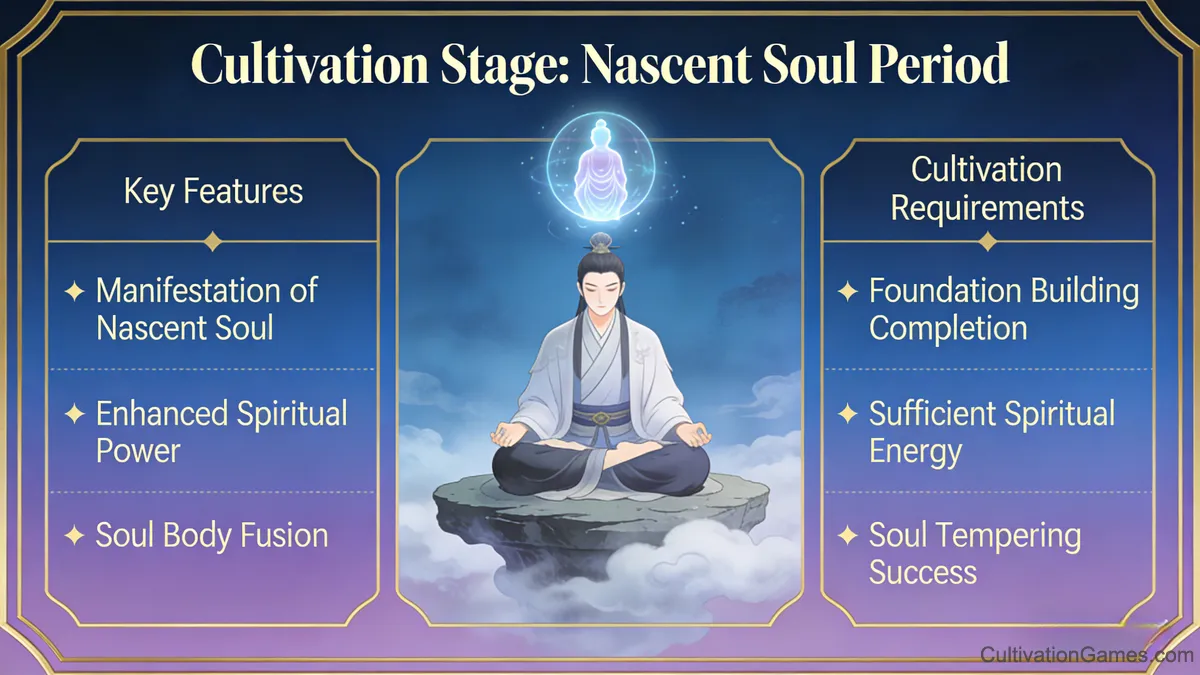
The Nascent Soul Realm, commonly referred to as Yuanying Jing, is the cultivation stage where a practitioner’s consciousness and Golden Core evolve into an independent spiritual entity known as the Nascent Soul.
Unlike the Core Formation Realm, which focuses on energy solidity, the Nascent Soul Realm represents the fusion of spirit, will, and cultivation base. At this stage, the cultivator is no longer fully bound to the physical body.
Across xianxia fiction and cultivation-based games, Nascent Soul is widely regarded as the threshold between high-level cultivators and true transcendental beings.
Common Names and Terminology
Term
Usage Context
Nascent Soul Realm
Standard English terminology
Yuanying Jing
Pinyin-based systems
Origin Soul Realm
Variant translations
Soul Birth Stage
Narrative-focused settings
Spirit Manifestation Realm
Game mechanics
Core Purpose of the Realm
The Nascent Soul Realm exists to accomplish the following transformations:
Externalize the cultivator’s consciousness
Create a semi-independent spiritual body
Allow survival beyond physical destruction
Establish direct interaction with laws and Dao
Once the Nascent Soul is formed, death of the physical body no longer guarantees true death.
Structure of the Nascent Soul
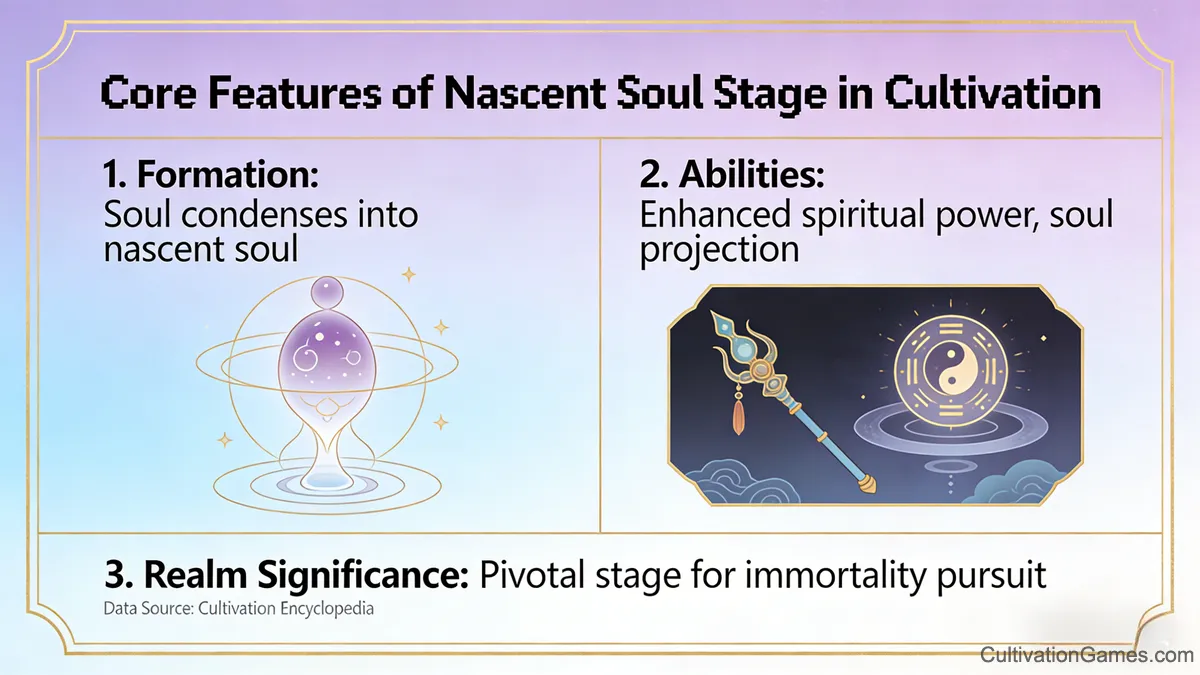
Key Features of Nascent Soul Stage in Cultivation
Feature
Description
Soul Form
Miniature spiritual body
Location
Dantian or spiritual sea
Mobility
Can exit physical body
Growth
Strengthens through cultivation
Stability
Determines survival after body loss
In many systems, the Nascent Soul visually resembles a smaller version of the cultivator, symbolizing self-awareness and spiritual maturity.
Attribute and Ability Expansion
Nascent Soul and the Shift from Body Dependency
Attribute
Nascent Soul Impact
Spiritual Sense
Massive range expansion
Spell Control
High-precision manipulation
Soul Attacks
Direct consciousness damage
Survival
Soul escape and possession
Dao Perception
Early law comprehension
Depictions in Games and Fiction
Amazing Cultivation Simulator
Nascent Soul introduces soul stability mechanics, soul damage types, and long-term survival systems. A damaged Nascent Soul can cripple a character permanently.
Immortal Taoists
This realm unlocks soul refinement systems, soul-bound artifacts, and advanced reincarnation mechanics.
A Record of a Mortal’s Journey to Immortality
Nascent Soul cultivators can abandon their physical body, possess others, or survive lethal destruction, emphasizing soul over flesh.
Tale of Immortal
Nascent Soul enables soul flight, advanced domain control, and direct law-based abilities.
Across these settings, Nascent Soul is treated as a qualitative leap in existence, not merely a numerical power increase.
Nascent Soul Formation Requirements
Requirement
Description
Perfect Golden Core
High purity and stability
Soul Refinement Technique
Shapes the Nascent Soul
Extreme Mental Stability
Prevents soul collapse
High-Grade Resources
Protects soul during birth
Favorable Timing
Reduces soul deviation
Risks and Failure Outcomes
Failure Type
Consequence
Soul Fragmentation
Permanent consciousness loss
Incomplete Soul
Weak or unstable Nascent Soul
Soul Deviation
Madness or loss of self
Soul Collapse
True death
In many games, soul damage is far more dangerous than physical damage and is often irreversible.
Most Important: Nascent Soul strength, stability, and independence.
The Nascent Soul is more than a power upgrade. In most cultivation games, it functions as a secondary core that directly affects damage output, survivability, and recovery from failure. A strong Nascent Soul allows aggressive play and reduces punishment for mistakes.
What Players Should Pay Attention To
Overall Nascent Soul strength and growth scaling
Stability of the soul during combat and high-risk events
Resistance to soul-based attacks and suppression effects
Whether the soul can operate independently of the physical body
In games like Tale of Immortal, weak Nascent Souls are easily disrupted or destroyed, leading to sudden deaths or heavy penalties. Well-developed souls, on the other hand, remain functional even when the body is compromised.
How Players Gain an Advantage at This Stage
Entering Nascent Soul with a high-quality Golden Core
Investing early in soul refinement instead of only boosting raw stats
Unlocking soul-based skills or protections before pushing high-risk content
Practical Outcome Difference
If done well:
Stronger and more reliable damage output
Better survival against soul-based enemies
Reduced death penalties or faster recovery
If done poorly:
Fragile soul that collapses under pressure
High vulnerability to debuffs and suppression
Frequent losses during elite fights or special events
Nascent Soul is the stage where characters stop relying entirely on their physical body and begin surviving through their soul.
The Moment Everything Changes: Nascent Soul Realm
If we’re being honest, the Nascent Soul Realm is where xianxia really starts to feel like xianxia. Before this, cultivators are strong, sure—but they’re still playing by mortal rules. Once Nascent Soul appears, those rules get bent, ignored, or quietly thrown out the window.
This is the stage where your cultivation literally gives birth to a second “you.” A tiny, radiant soul infant forms where your core used to be, and from that moment on, your existence becomes a lot harder to erase.
The Famous “Second Life”
Everyone remembers their first Nascent Soul escape scene.
The body gets blown apart. Blood everywhere. The enemy thinks it’s over—and then a streak of light shoots into the sky. That’s the Nascent Soul running for its life.
Across countless novels, this becomes the defining mechanic of the realm. As long as the soul infant survives, the cultivator survives. It can flee, hide, possess a new body, or slowly rebuild. Killing someone at this level stops being about winning a fight and starts being about completely sealing their soul.
This is why Nascent Soul cultivators are treated with real caution. They’re hard to kill, harder to finish off, and very good at holding grudges.
Not All Nascent Souls Are Created Equal
Reaching Nascent Soul is impressive. Having a *good* Nascent Soul is something else entirely.
Many stories turn this into an internal ranking system. The soul’s brightness, stability, and color all become shorthand for future potential. Ordinary cultivators get fragile soul infants that can barely leave the body. Protagonists, of course, end up with absurd versions that glow, radiate pressure, or sit cross-legged like miniature immortals.
This lets authors keep tension alive. Two characters may both be Nascent Soul cultivators, but everyone knows who the real monster is the moment the soul infant appears.
Nascent Soul Quality and Potential Explained
Divine Sense Stops Being Polite
Before this realm, Divine Sense is mostly utility—scouting, searching, checking what’s behind the wall. At Nascent Soul, it turns aggressive.
A fully formed soul carries weight. When a Nascent Soul cultivator releases their Divine Sense, weaker cultivators don’t just feel watched—they feel crushed. Knees buckle. Thoughts slow. Sometimes people pass out or die without a single spell being cast.
It’s one of the genre’s favorite flexes: the expert stands still, the pressure rolls out, and everyone else realizes how far apart they really are.
The Body Becomes Optional
Once the soul infant exists, the body quietly loses its status as “core component.”
Characters start treating flesh like equipment. Damaged bodies can be abandoned. Aging stops being scary. Some cultivators even cultivate specifically for soul survival rather than physical strength.
This shift also explains a personality change you see all the time. Nascent Soul cultivators often feel colder, calmer, and more distant. When your heart isn’t what keeps you alive anymore, it’s hard to stay fully human.
Why This Realm Is So Loved
The Nascent Soul Realm sits at a perfect spot in the progression ladder. Cultivators are terrifying, but still relatable. They can die, but not easily. They’re powerful, but not untouchable.
It’s the stage where sect ancestors appear, where grudges start lasting centuries, and where the world suddenly feels much bigger. For many readers and players, this is the realm where the fantasy truly delivers on its promise.
[Author’s Note: In games, this is usually where everything opens up. Second lives, long-distance teleportation, soul-based combat, and real endgame systems all start here. It’s no coincidence—Nascent Soul is where the training wheels come off.]
Nascent Soul FAQ
Is the "Core Shattering" process as scary as it sounds?
It’s absolutely as intimidating as it seems. After spending centuries perfecting your Golden Core, the last thing you want is to break it. But breaking the core is necessary for the Nascent Soul breakthrough. Imagine a caterpillar turning into a butterfly—everything has to collapse and rebuild. In novels like A Will Eternal, this isn't just an upgrade; it’s a gamble with high stakes. If you fail the "shattering," you risk losing not just your cultivation but your sanity or even your life. But when that little soul finally opens its eyes, you’ll realize you’ve left your mortal shell behind, stepping into true divinity. Just remember, a stable mind is key—don’t let your past regrets cloud the process.
Does having a "Second Life" make me invincible?
Not quite! While the Nascent Soul gives you a huge safety net, it doesn’t make you invincible. If your body is destroyed, your Nascent Soul can escape and leave the "meat suit" behind. It’s the ultimate escape option, but there’s a catch. You can find a new body, though it often comes with painful consequences. In games like Tale of Immortal, it’s your "insurance policy." But a Nascent Soul without a body is extremely vulnerable. Specialized Soul-Reaping artifacts or ghost-cultivators can easily trap or destroy your soul. It’s like being a powerful wizard with only one HP—sure, you have all the power, but a single hit could end your existence.
Why is everyone talking about "Teleportation" now?
The good news is, you can finally stop walking. Reaching Nascent Soul unlocks the ability to Teleport or Blink. Now that your soul is the core of your power, you can tune your frequency to match the laws of the world and slip through space. In PvP situations, this makes you nearly untouchable to lower-level cultivators. You’re not just moving fast; you're bypassing all obstacles. If you've read Renegade Immortal, you know how Wang Lin uses this ability to crush his enemies. But don’t get too cocky; mastering Blink takes practice. You’ll want to perfect it before using it in a life-or-death situation.
Can my mini-me actually fight on its own?
This is the fun part of being at the Nascent Soul stage. Your mini-me, or Nascent Soul, is a condensed version of your power. It can be projected outside your body to scout or even attack. Think of it as a drone that can cast powerful spells. In many cultivation RPGs, you can multitask with your Nascent Soul—your physical body can be in seclusion, while your soul-baby handles quests or battles. But be careful—if your Nascent Soul gets captured while it's roaming, your day just went from bad to catastrophic.
Why is the "Soul Search" technique so controversial?
Once you reach Nascent Soul, your brain undergoes a huge upgrade, giving you the ability to use Immortal Sense. This enables you to perform the Soul Search technique—essentially reading someone’s soul like a hard drive. Want to know their secrets, or where they’ve hidden their treasures? Just grab their head and start searching. It’s brutal and often leaves the victim in a mindless state. In many games, this is considered a "Dark Path" skill because of its ruthless nature. But in a world where survival is key, sometimes you’ve got to get your hands dirty to stay ahead. After all, it’s kill or be killed in the world of cultivation.
[Disclaimer: The following content is part of a cultivation game or fictional universe. It does not represent reality. All concepts are derived from xianxia novels and gaming mechanics.]