
Soul Transformation
The Soul Transformation Realm (Huashen Jing) marks the evolution of the Nascent Soul into a law-infused existence. Learn its mechanics, domains, risks, and depictions in games and novels.
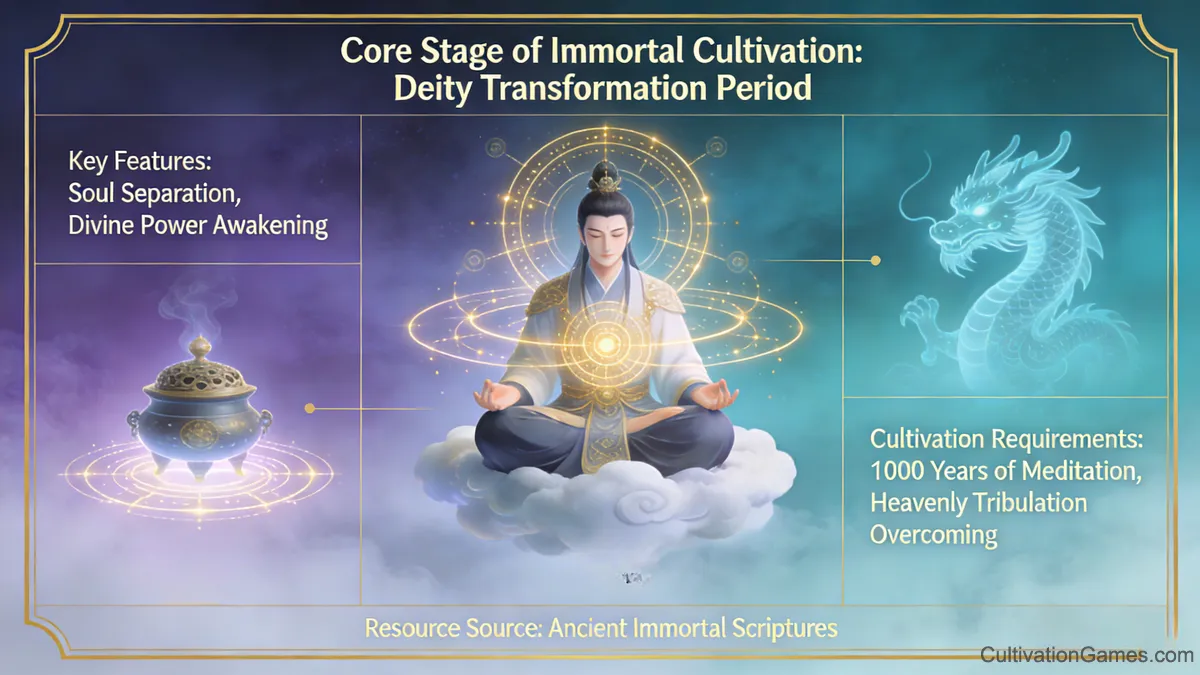
Realm Overview
The Soul Transformation Realm, commonly referred to as Huashen Jing, is the stage where a cultivator fully transforms their Nascent Soul into a higher-order spiritual existence capable of partial law manifestation.
Unlike the Nascent Soul Realm, where the soul is independent but immature, Soul Transformation represents qualitative evolution. The cultivator’s soul begins to merge with natural laws, forming a proto-domain that influences reality itself.
Across cultivation fiction and games, Soul Transformation is often depicted as the final realm before entering true Dao-level existence.
Common Names and Terminology
| Term | Usage Context |
|---|---|
| Soul Transformation Realm | Standard English usage |
| Huashen Jing | Pinyin-based systems |
| Soul Metamorphosis Realm | Narrative translations |
| Spirit Ascension Stage | Game mechanics |
| Law Integration Realm | Hybrid systems |
Core Purpose of the Realm
The Soul Transformation Realm exists to achieve the following objectives:
- Elevate the Nascent Soul into a law-infused entity
- Establish a personal spiritual domain
- Enable partial manipulation of natural laws
- Sever remaining Mortal limitations
At this stage, cultivators no longer rely solely on energy output, but instead exert conceptual influence over their surroundings.
Structural Characteristics
| Feature | Description |
|---|---|
| Soul State | Transformed, law-infused |
| Domain | Passive influence field |
| Autonomy | Fully independent existence |
| Law Affinity | Elemental or conceptual |
| Stability | Determines future ascension |
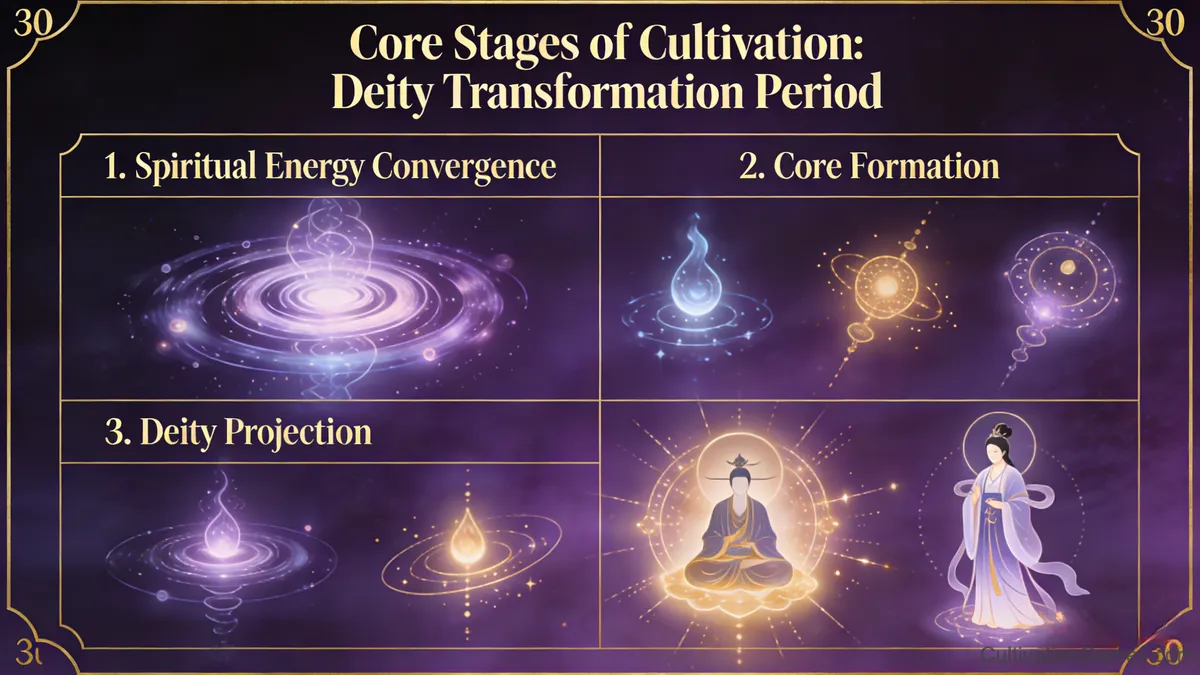
The quality of Soul Transformation determines whether a cultivator can advance toward higher Dao realms.
Attribute and Capability Expansion
| Attribute | Soul Transformation Impact |
|---|---|
| Domain Control | Area-based suppression |
| Law Interaction | Partial rule manipulation |
| Soul Defense | Extreme resistance to soul attacks |
| Lifespan | Several thousand years |
| Existence Stability | Survival beyond body and soul damage |
Depictions in Games and Fiction
Amazing Cultivation Simulator
Soul Transformation introduces domain mechanics, law compatibility checks, and large-scale environmental influence. Domain instability can permanently cripple progression.
Immortal Taoists
This realm unlocks law refinement systems, passive suppression effects, and advanced reincarnation safeguards.
Renegade Immortal
Soul Transformation cultivators demonstrate proto-law mastery, exerting pressure that alters space, perception, and causality.
Tale of Immortal
Soul Transformation grants territory control, law-aligned techniques, and resistance to lower-realm suppression.
Across these systems, Soul Transformation is treated as the threshold of conceptual power, not merely a power increase.
Soul Transformation Requirements
| Requirement | Description |
|---|---|
| Mature Nascent Soul | Fully stabilized soul entity |
| Law Comprehension | Elemental or conceptual |
| Domain Seed | Forms the basis of influence |
| Extreme Willpower | Maintains identity during fusion |
| High-Grade Resources | Prevents law backlash |
Risks and Failure Outcomes
| Failure Type | Consequence |
|---|---|
| Law Rejection | Domain collapse |
| Soul Dissolution | Irrecoverable death |
| Identity Loss | Assimilation into natural law |
| Domain Fracture | Permanent power reduction |
In many games, failure at this stage is irreversible and often results in character deletion or forced reincarnation.
💯Soul Transformation Realm – Key Gameplay Focus
Most Important: Soul evolution, control, and projection capability.
Soul Transformation is where the Nascent Soul stops being a fragile core and becomes an active combat and utility tool. This stage determines whether the soul can operate independently, attack at range, and survive high-tier encounters without collapsing.
What Players Should Pay Attention To
Whether the soul gains access to projection, avatar, or long-range abilities
Stability of soul form during extended combat
Resistance to suppression, sealing, or soul-damage mechanics
Control accuracy and cooldown reliability of soul-based skills
In many cultivation games, including Tale of Immortal, players who neglect soul refinement at this stage find their new abilities unreliable or easily countered.
How Players Gain an Advantage at This Stage
Strengthening soul control before pushing late-game enemies
Unlocking defensive soul mechanics, not just offensive ones
Avoiding content that stresses soul stability until proper upgrades are complete
Practical Outcome Difference
If done well:
Reliable long-range or off-body combat options
Safer engagement with elite or boss-level enemies
Much lower risk during high-difficulty events
If done poorly:
Soul abilities that fail under pressure
High vulnerability to control and suppression
Forced reliance on physical combat despite higher realm
Soul Transformation is the stage where the soul either becomes a true weapon or remains a liability.
Observations on the Soul Transformation Realm
In advanced xianxia settings, the [Soul Transformation Realm]—also referred to as Spirit Severing or Hua Shen—is widely portrayed as a qualitative shift in how power functions. While earlier realms focus on refining the body, energy, and soul, this stage centers on comprehension and authority. Power is no longer defined by internal reserves, but by the practitioner’s alignment with universal principles.
At this level, cultivators are often depicted as intermediaries between the individual self and the laws that govern reality.
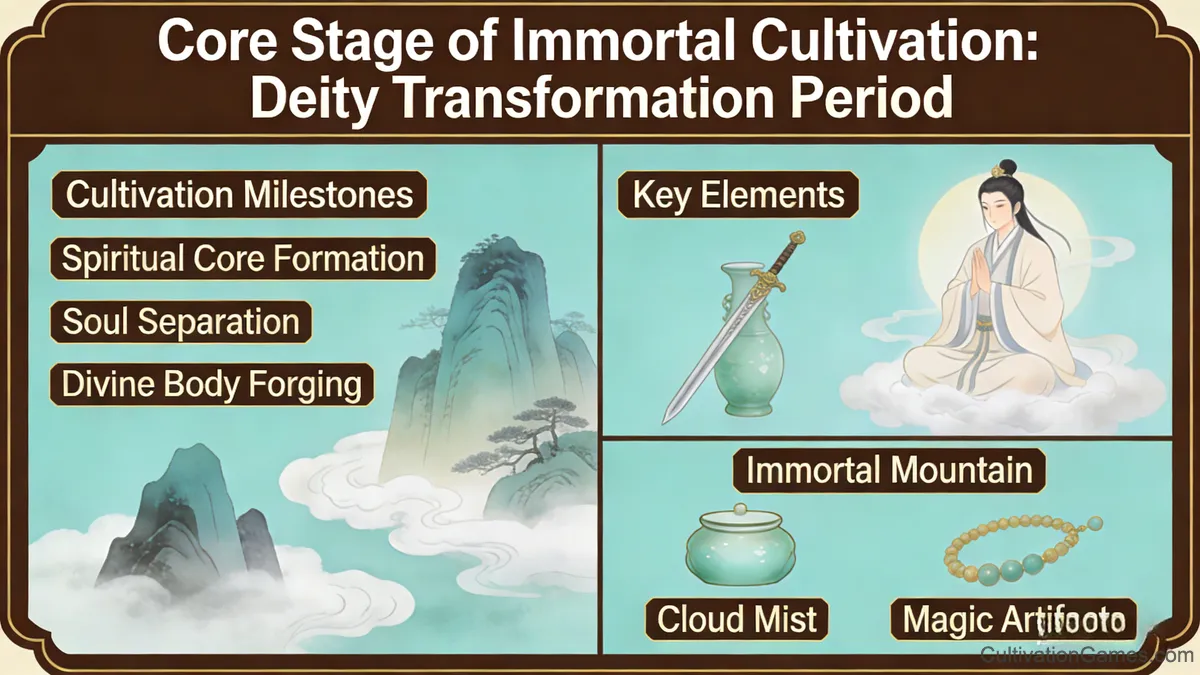
Deity Transformation Period - Key Elements and Characteristics
The Mortal Transformation Paradigm
A recurring trope, particularly in works like *Renegade Immortal*, is the requirement to undergo a “Mortal Transformation.” Practitioners temporarily seal their cultivation and live as ordinary humans, experiencing the full cycle of mortal life.
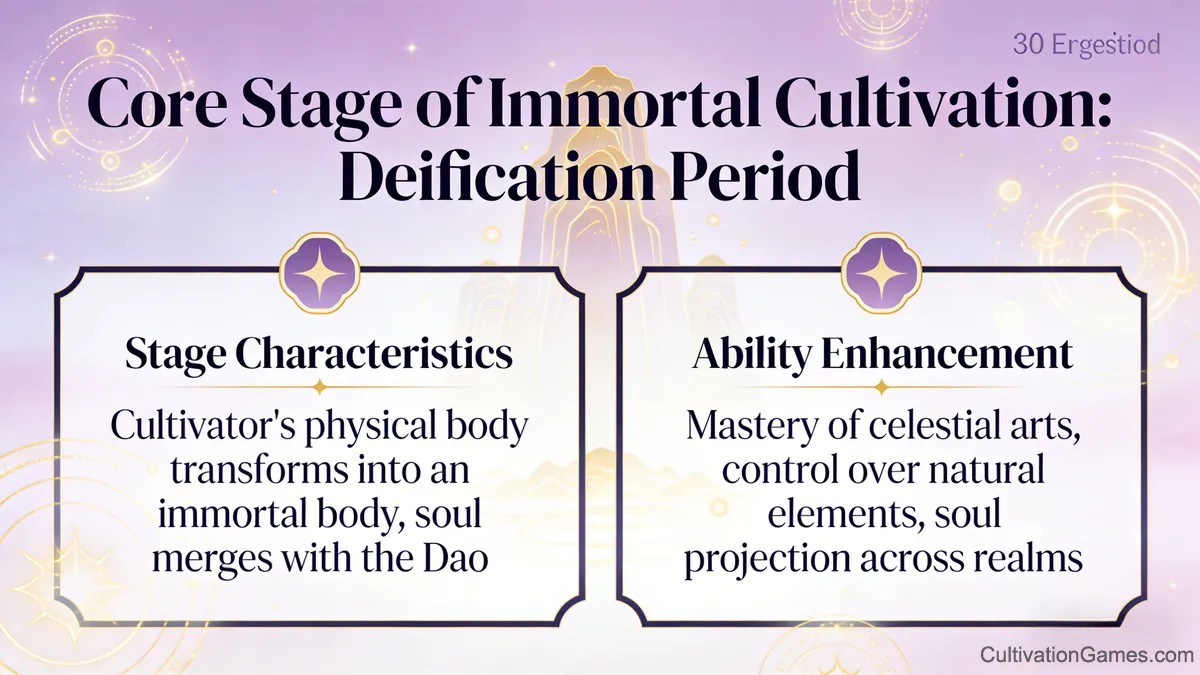
Within genre logic, this process serves a specific function: understanding the Dao of the world requires first understanding existence without power. The insights gained during this period are often crystallized into an “Intent,” which functions as a conceptual force rather than a technique.
Intent as a Combat Mechanism
Combat at the Soul Transformation level is frequently portrayed as intent-driven rather than energy-driven. A cultivator with a sufficiently developed Intent can suppress, immobilize, or dominate weaker opponents without direct attacks.
This represents a narrative transition from exerting force to asserting meaning. Fire, lightning, or wind are no longer summoned; they are commanded through alignment with the principles they represent.
Domain Expansion and Environmental Authority
The expansion of Divine Sense in this realm is commonly described as forming a “Domain” or “Field.” Within this space, the cultivator’s will subtly alters environmental behavior, energy flow, and even probability.
In game systems, this is often implemented as persistent area effects or reality-altering auras. Narratively, it reflects the idea that the soul has grown large enough to impose structure upon its surroundings.
The Act of Spirit Severing
In some interpretations, advancement requires the literal severing of attachments—memories, emotions, karmic ties, or aspects of identity. This “Severing” is framed as irreversible and foundational.
The quality of Soul Transformation is frequently linked to what was cut away and how decisively it was done. As a result, this realm often serves as a moral and existential checkpoint rather than a purely technical one.
Summary of Genre Conventions
Across cultivation fiction, the Soul Transformation Realm represents the emergence of authority-based existence. Cultivators are no longer defined by what they possess internally, but by how they influence and interpret reality itself.
This realm establishes the conditions necessary for Void-level cultivation, where even Intent must be refined or dissolved. From this point forward, advancement is less about growth and more about Transcendence.
[Author’s Note: In gameplay terms, this stage often introduces large-scale environmental control, karma systems, or law-based mechanics. The character transitions from participant to governing force within the world.]
Soul Transformation FAQ
Is "Comprehending the Dao" just a lore feature, or does it impact gameplay?
If you're coming from the Nascent Soul stage, you're probably used to grinding pills and spirit stones. But at Soul Transformation, everything changes. In novels like Renegade Immortal, Wang Lin spent years simply "sensing the world" to truly Enlighten himself. Why? Because you need Enlightenment to advance. In most cultivation RPGs, if your "Insight" or "Comprehension" stats are too low, you'll hit a wall. It’s no longer about pushing Qi into your body—it’s about understanding how the universe’s laws work. This stage is a complete shift from physical grinding to mental mastery. If you can’t grasp your chosen Law, don’t expect to move forward.
Why are "Domain" powers so overpowered?
Ever entered a boss room, only to have your stats drop drastically? That’s the effect of a Domain. When you reach Soul Transformation, you’re no longer just casting spells; you're bending reality around you to obey your will. It’s like having a private server for your personal rules. In games like Tale of Immortal, a Soul Transformation master can suppress thousands of lower-level cultivators just by standing still. Without your own Domain to counter theirs, you’re essentially a sitting duck. It’s a power trip that lets you control your own little slice of reality.
Why do I need an "Avatar" or "Separated Soul" at this stage?
This is one of the most exciting features of the late game. You can split your soul and create a fully functional Avatar. This isn’t just a clone; it’s a self-sustaining version of yourself that can handle quests or explore dangerous areas while your main body stays in seclusion. In stories like Martial Peak, avatars are used to explore hazardous ruins without putting your main body at risk. It’s the ultimate multitasking tool. And if your main body gets trapped in a sticky situation, having an Avatar to fall back on is the best "extra life" you can get.
Can a Soul Transformation master really travel between worlds?
At this stage, you start outgrowing your "Starter Planet" or "Lower Realm." Your presence is so powerful that the local space begins to feel "cramped." In novels, this is when the Heavenly Laws begin attempting to expel you—a process called Ascension. In many games, this unlocks access to higher-tier maps. You’re no longer a big fish in a small pond; you’re ready to experience an entire new world. But be warned: once you ascend, you may find yourself back to square one in a world full of powerful beings. It’s a humbling but thrilling step forward.
Canonical Inspirations
The Soul Transformation Realm consistently draws inspiration from:
- Renegade Immortal
- A Record of a Mortal’s Journey to Immortality
- Desolate Era
- Immortal Taoists
- Amazing Cultivation Simulator
- Tale of Immortal
Despite variations, all portray Soul Transformation as the stage where cultivators begin to impose meaning upon reality.
[Disclaimer: This content is derived from xianxia literature and gaming mechanics. It is for entertainment and world-building reference only.]
Author: cultivationgames · Chinese xianxia writer & cultivation game enthusiast
© Original content. Reproduction requires attribution. cultivationgames.com
What is the Soul Transformation Realm?
The Soul Transformation Realm is the stage where a cultivator evolves the Nascent Soul into a law-infused spiritual existence capable of influencing reality.
What changes during Soul Transformation?
During Soul Transformation, cultivators gain domain influence, partial law manipulation, and extreme soul stability.Why is Soul Transformation considered a major threshold?
Soul Transformation marks the transition from energy-based power to conceptual and law-based influence.Is Soul Transformation more dangerous than Nascent Soul?
Yes. Failure can result in law backlash, identity loss, or complete dissolution of existence.
What comes after the Soul Transformation Realm?
After Soul Transformation, cultivators typically advance toward Dao Integration or Ascension-level realms.
Related Categories
- Explore more in "Cultivation Realm" VIEW ALL