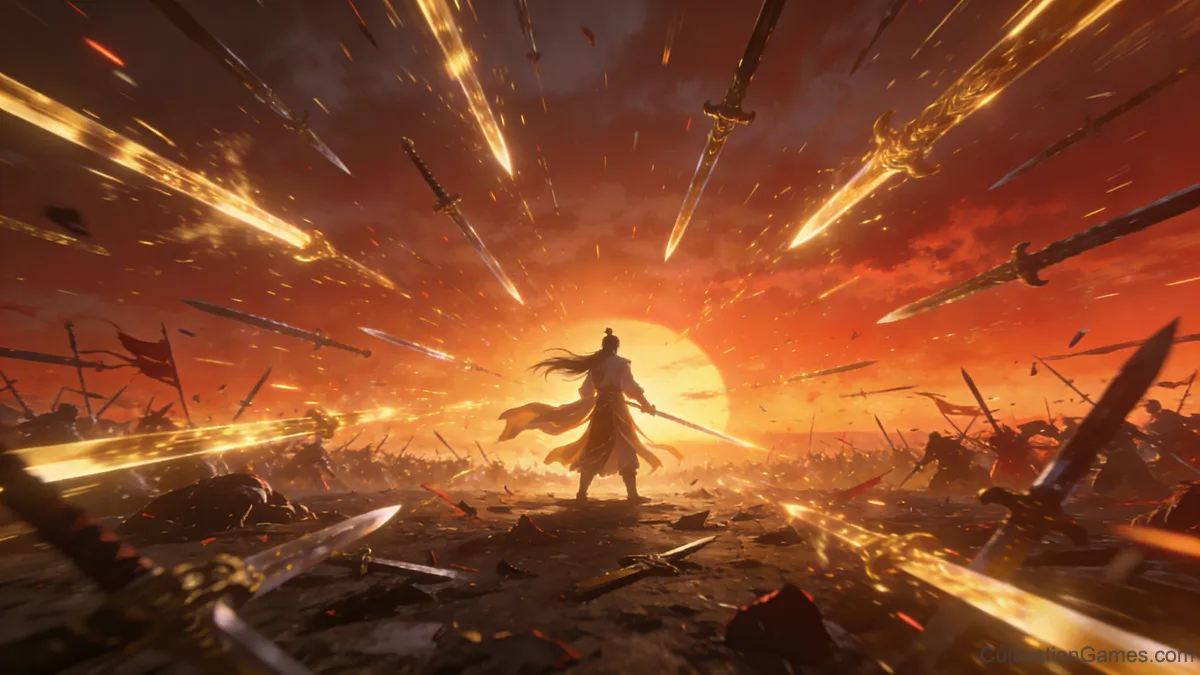
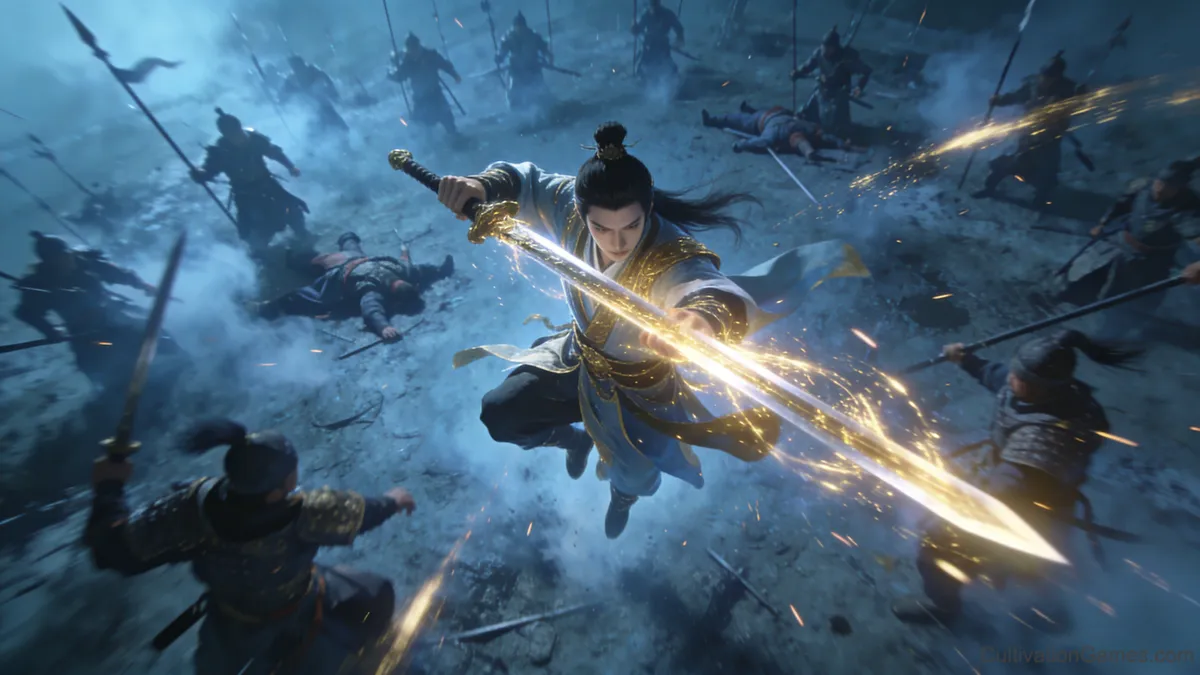
A Sword Cultivator specializes in refined weapon control, focusing on precision, speed, and flying sword techniques. Rather than brute force, they rely on positioning, timing, and skill chaining to overwhelm enemies. Sword cultivators are often portrayed as elite duelists with high burst damage but limited tolerance for mistakes.
Note: For entertainment only. Fictional mechanics—Do not attempt in real life.
Strengths & Weaknesses
Aspect
Strengths
Weaknesses
Damage
High burst, strong single-target DPS
Sustained damage can drop if skills miss
Range
Medium to long (flying swords)
Requires proper positioning
Defense
Mobility-based survivability
Low raw defense and HP
Skill Ceiling
Very high
Punishing for beginners
Gameplay Considerations (With Examples)
Almost every cultivation game or novel has this moment.You see someone flying through the battlefield, swords filling the screen, enemies dying before they even get close. No chanting. No setup. Just clean, violent efficiency.
That’s usually a Sword Cultivator.
But here’s the part people don’t tell you upfront: most sword builds feel awful before they feel amazing. And a lot of players never make it past that phase.
I didn’t, the first time.
In Tale of Immortal, Sword Cultivators are famously fragile. Early-game sword builds often die in two or three hits if positioning is poor. You must actively dodge projectiles, kite bosses, and rely on sword aura skills to deal damage from mid-range.
Doing it right means stacking weapon damage, sword intent, cooldown reduction, and projectile speed, allowing you to melt bosses before they touch you. Doing it wrong—standing still or over-investing in damage without mobility—usually results in constant deaths, especially against fast melee elites or AoE-heavy bosses.
The most concerning questions you have
Quickly providing clear answers for you to get started fast.
Is Sword Cultivator good for beginners?
Yes. Sword Cultivator is one of the most beginner-friendly classes in cultivation games because it has simple mechanics, high mobility, and consistent damage without complex resource management.
Is Sword Cultivator strong in casual gameplay?
Yes. Sword Cultivator performs very well in casual play due to its reliable damage output and low dependency on perfect gear or advanced optimization.
What is the playstyle of a Sword Cultivator?
Sword Cultivators focus on fast attacks, precise timing, and high mobility. Most builds emphasize direct combat using sword techniques or flying swords rather than long preparation or passive setups.
Is Sword Cultivator overpowered?
Sword Cultivator is usually balanced rather than overpowered. It often feels strong in early and mid-game stages but requires skill and optimization to stay competitive in late-game content.
Is Sword Cultivator viable in late game?
Yes, but most Sword Cultivators need optimized builds or hybrid strategies in late game. Pure sword damage may scale less effectively, so players often combine elemental laws or artifact synergies.
Is Sword Cultivator good for solo play?
Yes. Sword Cultivators are excellent for solo play because of their mobility, burst damage, and ability to handle enemies without relying heavily on team synergies.
What makes Sword Cultivator different from other cultivators?
Sword Cultivators specialize in direct, fast-paced combat and personal skill. Other cultivators often rely more on preparation systems like alchemy, formations, or long-term buffs.
Do Sword Cultivators require heavy grinding?
No. Sword Cultivators generally perform well with average equipment and moderate grinding, making them suitable for relaxed or time-limited players.
What Sword Cultivation Actually Feels Like in Games
Most newcomers assume Sword Cultivators are melee fighters. That assumption kills more runs than bad RNG ever will.
In practice, sword cultivation plays closer to a high-mobility ranged DPS. If you’ve played Tale of Immortal, Amazing Cultivation Simulator, or even action-heavy roguelikes with blade projectiles, you already know the rhythm.
You are constantly repositioning. You are always one mistake away from death. And when it works, it feels unfair—in your favor.
The core loop is simple:
Keep distance
Control space with sword techniques
Let Sword Qi do the killing while you stay untouched
When people say Sword Cultivators are “fragile,” they’re not exaggerating. Early on, you feel like a glass ornament in a hurricane.
The Power Curve Nobody Warns You About
Sword Cultivators have one of the most uneven power curves across cultivation realms.
Early Game: Qi Condensation → Foundation Establishment
This part is rough. Honestly, sometimes boring.
Your swords are slow. Your range is limited. Enemies don’t respect you yet.
In Tale of Immortal, this is the stage where many players abandon sword builds and reroll Body Cultivation because it feels safer. And they’re not wrong—at this point.
Mid Game: Core Formation → Nascent Soul
This is where everything changes.
Once you unlock multi-sword techniques, on-hit effects, or sustained Sword Intent mechanics, the screen starts to tilt in your favor. Enemies die off-screen. Boss patterns stop mattering as much.
In novels like A Record of a Mortal’s Journey to Immortality, this is exactly where sword-focused cultivators start punching above their realm, defeating opponents who technically “should” be stronger.
Not because they’re tankier. Because they never get touched.
Late Game: Ascension Toward Sword Immortal
At higher realms, Sword Cultivators stop playing the same game as everyone else.
You’re no longer reacting—you’re dictating. Fights end fast or not at all. Your biggest enemy becomes visual clutter and cooldown management, not enemy mechanics.
Some players joke that late-game sword builds are limited only by frame rate. That joke exists for a reason.
Why Sword Cultivators Win Above Their Realm
This shows up constantly in both games and novels.
In I Shall Seal the Heavens, sword-focused characters routinely defeat cultivators one or even two realms higher—not because they have more power, but because sword techniques compress damage and timing.
Sword cultivation rewards:
First-strike advantage
Burst windows
Perfect positioning
In PvE, this means bosses melt before their mechanics ramp up. In PvP-style encounters, it means fights are decided in seconds.
If a Sword Cultivator doesn’t win quickly, they usually lose.
There’s no middle ground.
Skill Synergies That Actually Matter
Numbers lie. Mechanics don’t.
Across different systems, Sword Cultivators tend to lean into one of two directions:
Sustained Pressure Builds
Bleed, burn, or stacking Sword Intent
Kiting-heavy playstyle
Extremely strong against slow or large bosses
Burst Mobility Builds
Dash, blink, or wind-based movement
Short invulnerability windows
Designed to erase targets before retaliation
In many games, combining sword techniques with movement skills is what separates average sword users from terrifying ones. If your build can’t move while dealing damage, it usually won’t survive higher difficulties.
PvE vs PvP: Two Very Different Realities
Against large monsters or world bosses, Sword Cultivators feel almost unfair. Predictable enemies can’t handle constant ranged pressure.
Against other cultivators, it’s tense.
One stun. One misstep. One failed disengage.
That’s all it takes.
Experienced sword players learn patience. They wait for cooldowns. They don’t overcommit. They disengage even when it feels wrong—because surviving is more important than flexing damage.
The Sword Cultivator Path
Most systems follow a familiar arc:
Sword Initiate: Learning control and spacing
Sword Adept: Managing multiple blades and effects
Sword Intent Master: Turning willpower into damage
Sword Immortal: The blade moves before thought
Not everyone reaches the end. Many don’t want to. Sword cultivation demands focus, precision, and tolerance for failure.
But for those who stick with it, nothing else feels quite the same.
So… Is Sword Cultivation Worth It?
If you want safety, no. If you want consistency, probably not.
But if you enjoy high-risk builds, mechanical mastery, and the feeling of ending fights before they begin—then yes. Absolutely.
Sword cultivation isn’t about raw stats. It’s about timing, distance, and control.
And when it clicks, you’ll understand why this path never stops attracting players—even when it punishes them for trying.
The Sword Cultivation Guide: High Risk, Unreal Reward
Let’s not pretend otherwise—almost everyone wants to be a Sword Cultivator.
There’s a reason every cultivation game forum is full of sword builds, clips of flying blades, and people arguing about whose screen melted faster. Sword cultivation looks insane when it works. Clean. Fast. Brutal.
But there’s a quiet truth behind all that flash.
Most sword players don’t fail because the build is weak. They fail because they play it like something it isn’t.
If you’re looking for a comfy, tanky playstyle where you can eat hits and shrug them off, you should probably close this tab now. Sword cultivation is a glass cannon lifestyle. One bad dash, one greedy step forward, and you’re staring at a reload screen wondering what just hit you.
I’ve been there. More than once.
How Sword Cultivation Actually Plays (Not How It Looks)
New players always make the same mistake: they treat swords like melee weapons.
They’re not.
In practice, a Sword Cultivator is closer to a ranged control build with absurd mobility. You live at the edge of your attack range, constantly moving, constantly adjusting. The goal isn’t to trade hits—it’s to make sure nothing ever touches you.
Your range is short. Your health pool is a joke. Every mob feels more dangerous than it should.
This is where most people quit sword cultivation and reroll into something sturdier. And honestly? I don’t blame them. Early sword play is all positioning and no payoff.
But if you stick with it, something starts to change.
The “Circle” Mindset
Sword cultivation clicks the moment you stop thinking about damage and start thinking about space.
I call it “the circle.”
You’re not charging enemies. You’re orbiting them. Staying just far enough that they’re always chasing, never catching. Every step you take forces them to waste time, animations, and positioning—while your Sword Qi keeps landing hits.
Once you reach Foundation Establishment, your toolkit finally opens up. More movement options. More sword behaviors. More ways to punish enemies for trying to close the gap.
At that point, fights stop feeling desperate and start feeling controlled.
Not safe. Controlled.
The Mid-Game Spike Nobody Forgets
Golden Core is where sword builds usually come alive.
Not all at once—but you feel it. One run you’re still dancing for your life, the next run the screen just clears itself. Sword builds tend to have extremely high hit frequency, and once you unlock passives that trigger on hit, everything snowballs.
By the time you reach Nascent Soul, a well-built Sword Cultivator often feels untouchable. Not because you’re tanky—but because you’re abusing movement, timing, and brief invulnerability windows.
You’re not surviving hits. You’re avoiding them entirely.
This is why sword-focused characters in cultivation novels so often punch above their realm. In stories like A Record of a Mortal’s Journey to Immortality, sword users don’t win by overpowering enemies—they win by ending fights before the enemy ever stabilizes.
Same logic. Different medium.
Why Sword Cultivators Feel “Unfair” at High Levels
Late-game sword cultivation doesn’t play the same game as other builds.
Against large monsters or world bosses, you’re oppressive. Predictable attack patterns mean free damage. Range means safety. Speed means forgiveness.
Against other cultivators, it’s the opposite.
Sword vs cultivator fights are tense and fast. If you don’t win quickly, you usually lose. One stun, one misread dash, one greedy push—and your entire advantage collapses.
That’s the real appeal for a lot of players.
Sword cultivation rewards awareness. It punishes autopilot. You’re always engaged, always watching cooldowns, always deciding whether to press or pull back.
The Stuff People Don’t Tell You
The Good
Insane single-target damage
Screens get cleared fast in late-game
Best movement skills in most systems
Nothing feels more “cultivation fantasy” than flying swords
The Ugly
You will die in two hits if you get lazy
Constant repositioning is mandatory
Gear matters a lot for smooth play
Early game can feel genuinely miserable
This isn’t a build you can half-play. Sword cultivation demands attention. When you give it that attention, it gives you power that feels borderline illegal.
The Classic Noob Traps
The biggest trap is stacking pure Attack and calling it a day.
I’ve lost more sword characters to bad movement than bad damage. If your movement speed is trash, enemies at higher realms will simply run you down. Damage doesn’t matter if you’re cornered.
Look for anything that helps you stay active:
Life sustain
Cooldown reduction
Mobility-enhancing effects
A Sword Cultivator without movement options isn’t a glass cannon. It’s just glass.
So… Who Should Actually Play Sword Cultivation?
Sword cultivation isn’t for everyone.
If you hate dying while learning, skip it. If you want slow, methodical fights, skip it.
But if you enjoy high-risk builds, skill expression, and the feeling of completely controlling the battlefield once everything clicks—then sword cultivation is hard to beat.
It’s not about numbers. It’s not about tanking.
It’s about distance, timing, and making every enemy feel like they’re already too late.
And once you get that feeling, it’s very hard to play anything else.