
Transcendence
Transcendence marks the end of cultivation systems, where Dao, realms, and power scaling no longer apply.
Realm Overview
Transcendence is not a cultivation realm in the traditional sense. It represents the termination of all internal progression systems, including realms, laws, attributes, and Dao structures.
Unlike Dao Ancestor, which still functions as a stabilizing pillar within existence, Transcendence marks the act of leaving the system itself. At this stage, power scaling, cultivation mechanics, and realm hierarchies no longer apply.
In most cultivation narratives and games, Transcendence exists as a conceptual endpoint, not a playable or repeatable stage.
Defining Features of Transcendence
| Aspect | Transcendence |
|---|---|
| Cultivation | Fully terminated |
| Dao | Abandoned |
| Authority | Undefined |
| Power Scaling | Invalid |
| Realm System | Exited |
Transcendence is defined by absence, not accumulation.
Transcendence vs Dao Ancestor
| Category | Dao Ancestor | Transcendence |
|---|---|---|
| Relation to Dao | Embodiment | Abandonment |
| System Position | Structural core | System exit |
| Power Measurement | Meaningful | Impossible |
| Narrative Role | Origin | Termination |
| Replaceability | Possible | Irrelevant |
In Renegade Immortal, Dao Ancestor-like entities still anchor reality, while Transcendence is portrayed as stepping beyond causality itself.
How Transcendence Is Portrayed in Games
Transcendence is rarely implemented as a progression tier. Instead, it functions as a soft ending condition or world reset trigger.
| Game | Representation |
|---|---|
| Amazing Cultivation Simulator | Leaving the world cycle |
| Tale of Immortal | Fate severance |
| Immortal Taoists | Ascension beyond system |
| Scroll of Taiwu | Narrative disappearance |
These depictions emphasize that Transcendence cannot be optimized or min-maxed.
Loss of Measurable Attributes
Upon Transcendence, all numerical systems collapse.
| System Element | Status |
|---|---|
| Levels | Removed |
| Stats | Undefined |
| Skills | Irrelevant |
| Lifespan | Non-applicable |
| Combat | Obsolete |
In Amazing Cultivation Simulator, characters who transcend are removed from simulation logic entirely.
Narrative Function
Transcendence often serves as a thematic conclusion rather than a victory condition.
Common narrative purposes include:
- Ending cyclical cultivation
- Rejecting eternal stagnation
- Escaping narrative determinism
- Denying power obsession
In Tale of Immortal, transcendence-style endings are framed as rejecting fate rather than defeating it.
Can Transcendence Be Reversed?
Most systems treat Transcendence as irreversible.
| Scenario | Outcome |
|---|---|
| Return attempt | Narrative paradox |
| Power usage | Impossible |
| Dao interaction | None |
| World influence | Indirect at best |
Returning from Transcendence typically requires author-level intervention rather than in-world logic.
Why Transcendence Is Not a Realm
Despite common usage, Transcendence lacks all defining traits of a realm:
- No progression
- No comparison
- No hierarchy
- No internal rules
It exists outside the ladder, not at the top of it.
Termination of the System: Understanding Transcendence
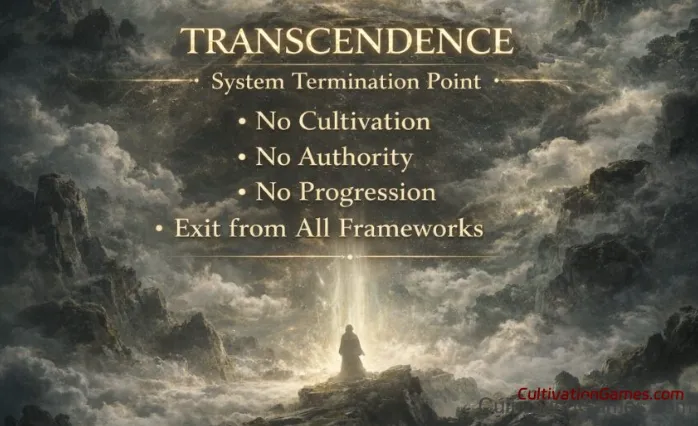
Transcendence represents the point at which all internal progression systems cease to function. Unlike prior realms, it does not extend cultivation mechanics, authority, or power scaling. Instead, it removes the entity entirely from the operational framework of the universe.
At this stage, advancement is no longer meaningful. The cultivator does not exceed the Dao; the cultivator exits it.
Severance from Law and Causality
All prior realms operate within causal structure. Saints enforce laws. Dao Ancestors monopolize them. Transcendence nullifies this relationship entirely.
A transcendent entity is no longer subject to:
- Cause and effect
- Temporal sequence
- Conceptual limitation
- Law-based interaction
Rather than rewriting laws, Transcendence exists where laws cannot be applied. Concepts such as time, death, or existence become optional reference points rather than governing principles.
Collapse of Hierarchy
There is no throne, rank, or authority beyond the Dao. Hierarchy requires structure, and structure requires laws. Once all law-based systems are exited, hierarchy becomes undefined.
As a result:
- There is no supreme ruler of Transcendence
- No accumulation of followers or territory
- No distinction between higher or lower states
Entities at this level are not rulers. They are not participants.
Non-Interaction with Reality
Transcendent existence is frequently described as unobservable by universal systems. Laws cannot detect, restrict, or respond to such entities.
When present within a universe, a transcendent being is treated as a non-addressable anomaly. Physical interaction, energetic interference, or conceptual targeting cannot occur because the entity is not indexed within the system.
Absence of Conflict
Conflict requires limitation. Combat requires shared rules. Since Transcendence exists beyond all frameworks, confrontation is structurally impossible.
Two transcendent entities cannot meaningfully oppose one another. At most, coexistence or mutual non-engagement occurs. Any attempt to frame conflict at this level collapses into abstraction rather than action.
The Paradox of Existence
Transcendence is frequently described through paradoxical language: simultaneous existence and non-existence, presence without locality, awareness without identity.
This paradox reflects the termination of definitional boundaries. Without systems to define states, contradiction loses relevance. The entity is not hidden; it is undefined.
Why Narratives End Here
From a structural standpoint, Transcendence eliminates narrative tension. Without risk, limitation, or opposition, progression cannot continue.
As a result, most cultivation narratives conclude upon reaching this stage. The journey has reached its logical endpoint: complete detachment from the system that enabled the journey itself.
Summary: Exit Beyond All Frameworks
Transcendence is not the peak of cultivation. It is the abandonment of cultivation entirely.
All realms below operate on accumulation, authority, or refinement. Transcendence operates on absence. It represents the final state where progression, identity, and structure dissolve.
Transcendence FAQ
Is Transcendence just another level cap increase?
Honestly, it’s not really a level. It’s more like "unplugging from the matrix." In games like Amazing Cultivation Simulator or hardcore Xianxia mods, even when you reach the peak of the Dao Ancestor realm, you're still bound by the logic of the world. Transcendence is when you step outside the "Circle." In stories like The Desolate Era, it’s when the protagonist realizes that the multiverse they’ve been fighting in is but a speck of dust in an even larger void. It’s the ultimate "Endgame" because there’s nothing left to cultivate. You've reached the very source itself.
Why do most cultivators fail at the very last step?
It’s the "Obsession" trap. To transcend, you have to let go of everything—your sect, your power, even your very Dao. Most high-level players fail because they can’t detach from their "Legendary Artifacts" or their "Invincible Status." This is often referred to as the Heart Devil of the Void in stories. If you still care about being "The Strongest," you're still tied to the concept of strength, meaning you haven’t truly transcended. It’s a psychological wall that no amount of grinding can fix. Isn't it ironic? To gain everything, you have to want nothing.
What happens to your "World" after you transcend?
This is a fascinating concept often discussed in Xianxia forums. After transcending, the universe you left behind becomes your "Shadow." You might become a silent guardian of that reality, or you may create an entirely new Multiverse from your memories. In some games, this translates to setting the "Starting Conditions" for a New Game Plus. You’re no longer a resident of your old world—you’ve become the architect. Your previous universe becomes a "Lower Realm" from your elevated perspective.
Can a Transcended being still interfere with the mortal world?
Usually, they don’t, and for good reason. A single thought from a Transcended being would rewrite the laws of a lower world so drastically it could collapse. It’s like trying to fix a watch with a sledgehammer. In novels, they might send a "Thought Avatar" or a tiny sliver of their will to guide a new protégé. If you encounter a "mysterious old man" in a starter village who seems to know everything, there's a high chance they’re just a bored Transcended being wanting to observe how the new generation handles the grind.
Is there anything beyond Transcendence?
Now, that’s the trillion-spirit-stone question. Once you’re outside the multiverse, what’s left? Most authors, like Er Gen or I Eat Tomatoes, leave this open-ended. It’s the "Grand Unknown." For a player, it’s that moment when you look at your 100% completion save file and realize the journey was the point, not the destination. You’ve reached the "True Reality," and what happens from here is entirely up to your imagination. Ready to close the book and start a new legend?
Common Terms & Names
In the highest tiers of cultivation lore, this stage is known as Transcendence, Detachment, The Great Beyond, or The Grand Awakening. For fans of I Shall Seal the Heavens, it’s referred to as reaching the Daosource or stepping beyond the Universe Vastness. This is the point where you stop being a character in the story and start being the one who writes how stories unfold.
[Disclaimer: The following content is part of a cultivation game or fictional universe. It does not represent reality. All concepts are derived from xianxia novels and gaming mechanics.]
Author: cultivationgames · Chinese xianxia writer & cultivation game enthusiast
© Original content. Reproduction requires attribution. cultivationgames.com
What is Transcendence in cultivation?
Transcendence is the act of leaving the cultivation system entirely, not a higher realm.
Is Transcendence higher than Dao Ancestor?
It is not higher but outside the hierarchy that includes Dao Ancestors.Can a transcended being still use power?
No. Power systems cease to function after Transcendence.Is Transcendence a cultivation realm?
No. Transcendence lacks progression, rules, and internal structure.
Do any games allow reaching Transcendence?
Some games depict it as a narrative ending rather than a playable stage.
Related Categories
- Explore more in "Cultivation Realm" VIEW ALL