
True Immortal
The True Immortal Realm defines cultivators who achieve fully self-sustaining existence without reliance on external laws or worlds.
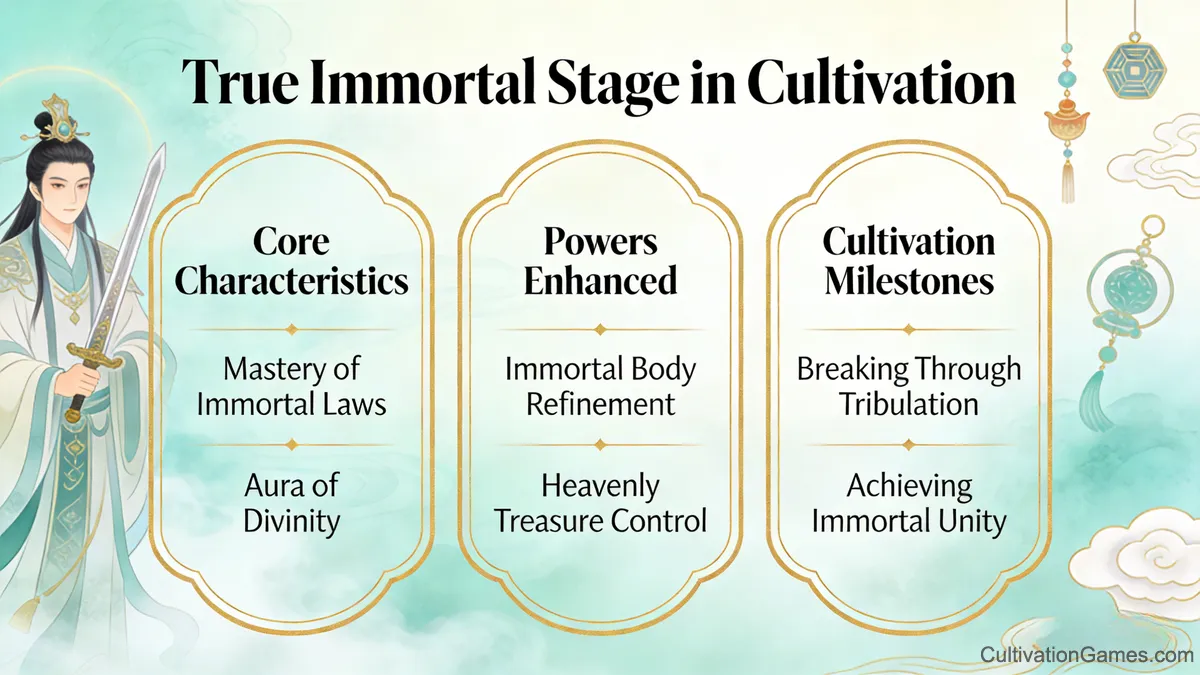
Realm Overview
The True Immortal Realm represents a state of existence where immortality is no longer conditional. Unlike standard Immortal stages that rely on external laws or world systems, a True Immortal is defined by self-sustaining existence.
At this level, survival is not dependent on lifespan removal, external domains, or borrowed Dao authority. The cultivator’s existence becomes internally complete.
In Renegade Immortal, this distinction is critical, as many Immortals remain bound to higher-plane rules, while True Immortals exist independently of system enforcement.
Defining Characteristics
| Aspect | True Immortal Standard |
|---|---|
| Lifespan | Self-sustained |
| Aging | Nonexistent |
| External Law Dependence | None |
| Existence Stability | Absolute |
| Regression Risk | Near Zero |
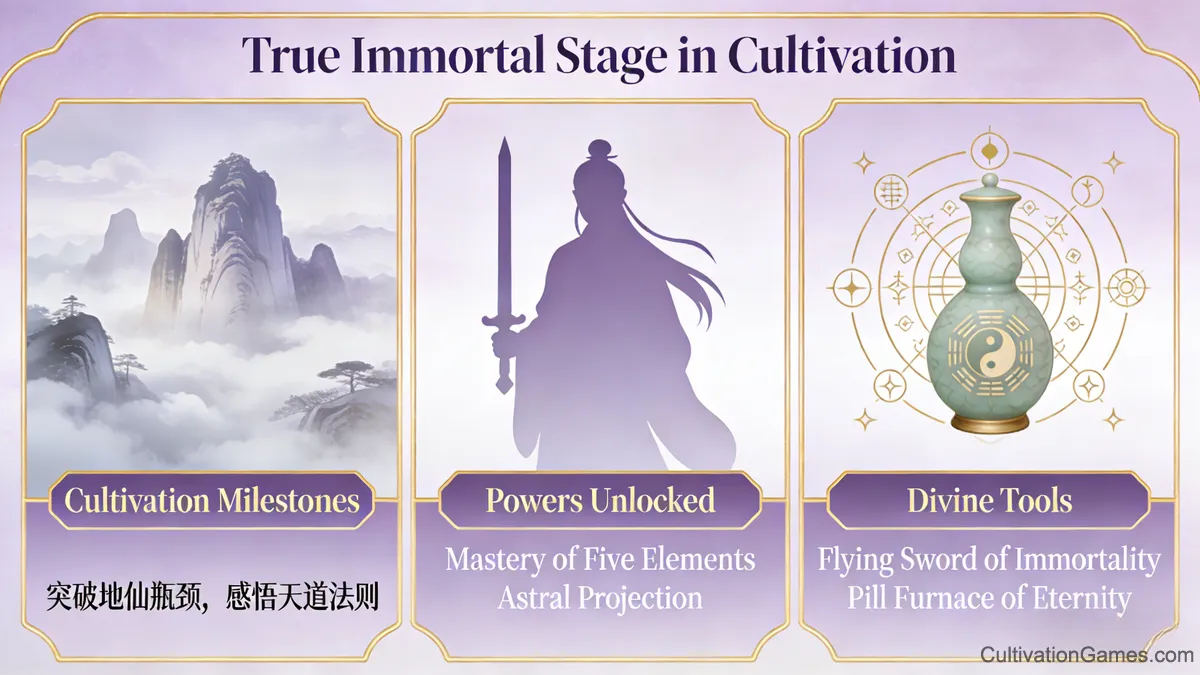
Unlike lower Immortal stages, True Immortals do not weaken when removed from their original environment. This concept is echoed in Desolate Era, where True Immortal entities persist even after world collapse.
Difference Between Immortal and True Immortal
| Category | Immortal | True Immortal |
|---|---|---|
| Law Reliance | External | Internal |
| Death Conditions | Multiple | Extremely Limited |
| World Binding | Common | None |
| Existence Anchor | World-based | Self-based |
Many cultivation games simplify immortality into a single tier, but advanced systems differentiate True Immortals as qualitatively superior rather than numerically stronger.
Power Expression
True Immortal power is not measured through raw damage output. Instead, it is expressed through existence priority.
| Attribute | Expression |
|---|---|
| Dao Authority | Intrinsic |
| Domain Presence | Optional |
| Regeneration | Automatic |
| Suppression | Passive |
| Energy Loss | Negligible |
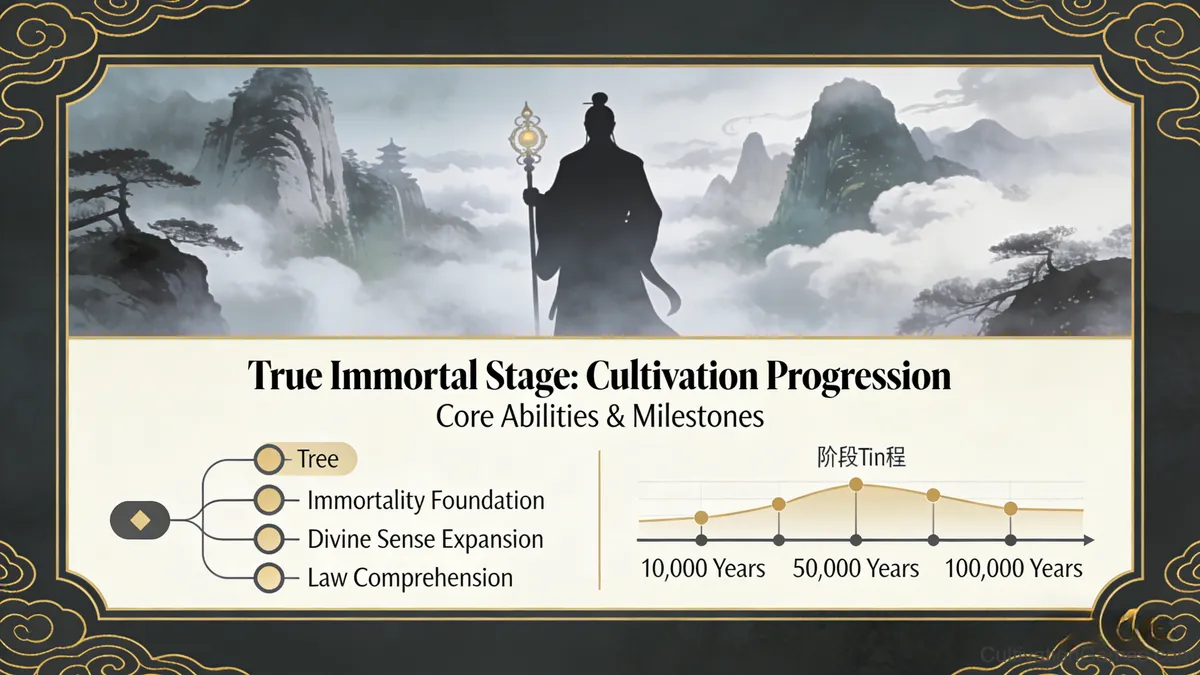
In Amazing Cultivation Simulator, this is represented by complete immunity to lifespan, environment, and stability penalties.
Representation in Games
Different games interpret True Immortality through mechanical abstraction.
| Game | Representation |
|---|---|
| Amazing Cultivation Simulator | Absolute stability state |
| Immortal Taoists | End-tier existence flag |
| Tale of Immortal | Fate-independent survival |
| Scroll of Taiwu | World-rule exemption |
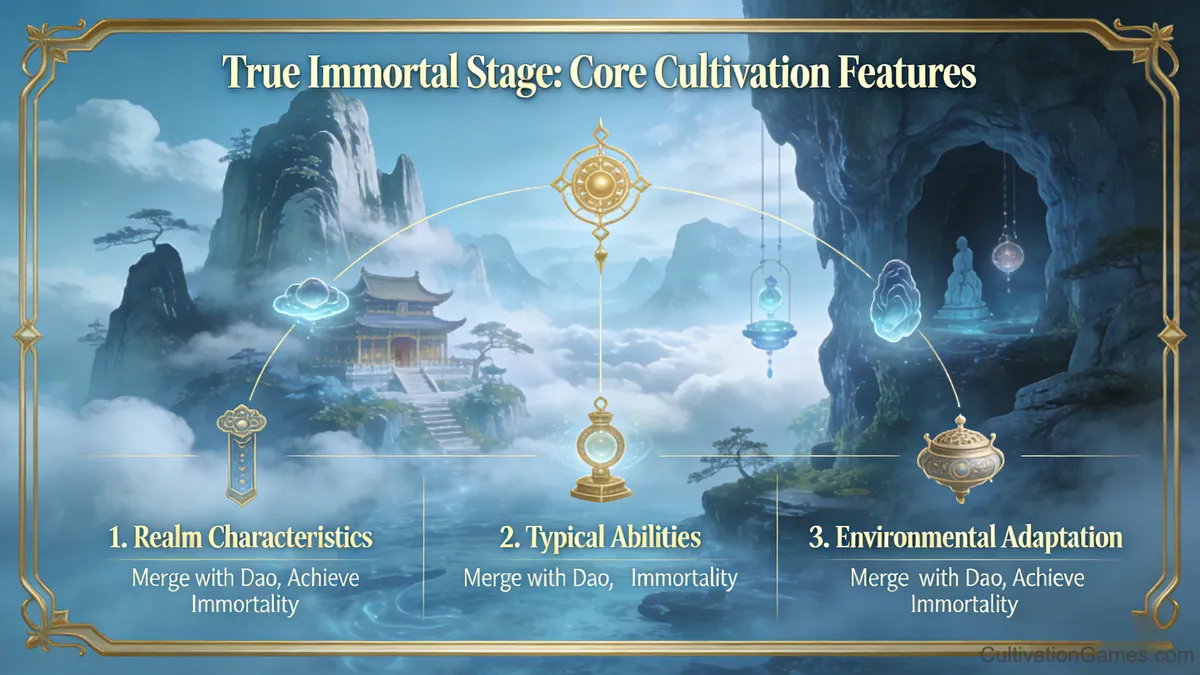
These implementations reinforce the idea that True Immortality is about system independence, not infinite stats.
Risks and Limitations
Even True Immortals are not omnipotent.
| Risk Type | Outcome |
|---|---|
| Dao Erasure | Total annihilation |
| Conceptual Destruction | Permanent removal |
| Higher-Order Suppression | Forced dormancy |
Narrative works consistently portray True Immortal death as final, with no reincarnation or recovery mechanisms.
Narrative and System Role
True Immortals often function as fixed points within a setting. They shape eras, define boundaries, or serve as reference entities rather than active participants.
In A Record of a Mortal Journey to Immortality, True Immortals are rarely seen, reinforcing their role as structural constants rather than characters.
💯True Immortal Realm – Key Gameplay Focus
Most Important: Immortal Qi adaptation and post-Ascension survivability.
After ascension, True Immortal is no longer about breakthrough mechanics. It is about learning how to survive and function in the Immortal Realm. Many games treat this stage as environmental adaptation rather than power growth.
What Players Should Pay Attention To
Immortal Qi absorption rate and efficiency
Immortal body constitution and resistance to Immortal pressure
Compatibility between Immortal Qi, techniques, and physique
Early Immortal Arts that reduce upkeep and instability
Characters that cannot efficiently absorb Immortal Qi often stagnate here.
How Strong Players Pull Ahead
Improving Immortal Qi circulation before chasing damage
Prioritizing Immortal Body Refinement over advanced techniques
Choosing Immortal Arts with low Qi consumption
Stabilizing post-ascension debuffs or penalties early
In many games, poorly adapted Immortals struggle even against lower-tier Immortal enemies.
Practical Outcome Difference
If done well:
Stable Immortal Qi income and smooth skill usage
Reduced maintenance cost and downtime
Faster access to higher Immortal systems
If done poorly:
Constant Qi shortages
Frequent instability or debuffs
Forced grinding just to maintain baseline performance
True Immortal is the adaptation phase of Immortal gameplay.
Players who stabilize early gain a massive long-term advantage.
So You’ve Reached the Heavens… Now What?
Crossing into the Immortal Realm feels amazing. Lightning, ascension, shedding mortality—the whole ceremony makes it feel like you’ve “made it.”
Then reality sets in.
In most xianxia worlds, the basic Immortal stage is just the lobby. The [True Immortal Realm] is where you finally get assigned a seat. This is the stage where heaven stops treating you like a temporary guest and starts treating you like part of the infrastructure.
That’s why it’s called *True* Immortal. You’re no longer borrowing immortal power—you’re generating it yourself, cleanly, continuously, and permanently.
Washing Away the Last of Mortality
One of the quiet but brutal themes of this realm is purification.
Even after ascension, most cultivators are still full of “mortal residue”—habits, instincts, and impurities carried all the way from their first breath as a human. The True Immortal Realm is where those leftovers get burned out.
Your Immortal Essence stops feeling rough and unstable. It becomes smooth, heavy, and frighteningly calm. Many stories describe this as your blood turning into jade fluid, your bones becoming law-forged frameworks, and your organs acting more like formation nodes than flesh.
At this point, normal injury stops making sense. Cutting a True Immortal is like scratching a rule written into reality.
You Stop Casting Spells
Low-level cultivators shout, gesture, and pray their techniques don’t misfire.
True Immortals don’t bother.
By this stage, most characters have grown a stable **Law Foundation**. Fire, time, frost, space—whatever their path is, it’s no longer a tool they wield. It’s something that listens to them.
Want flames? The concept of heat responds.
Want silence? Space cooperates.
This is where fights stop being flashy and start being terrifying. The most dangerous attacks often look like nothing happened—until the other side realizes the rules they relied on no longer apply.
Essence Density: Why Weak Immortals Don’t Last
One thing novels and games are very clear about: not all immortals survive long enough to become True Immortals.
The key difference isn’t raw power. It’s **density**.
True Immortal Essence is compressed, stabilized, and painfully real. It can endure Origin Law pressure that would shred a normal Immortal’s soul apart. This is why skipping refinement steps almost always ends badly. Characters who rush breakthroughs don’t just fail—they fracture, scatter, or get rewritten into environmental hazards.
There are entire celestial ruins made of failed immortals who thought they could “wing it.”
The Shift From Lone Cultivator to Power Figure
Socially, this is where everything changes.
A True Immortal is no longer background noise in the heavens. They’re a recognized existence. Sects recruit them. Realms negotiate with them. Enemies start planning centuries ahead.
In many stories, this is the realm where protagonists stop wandering and start *owning* things—territories, domains, inheritances, even small worlds. It’s not arrogance; it’s survival. If you don’t anchor yourself somewhere, someone stronger will decide where you belong.
When Laws Bite Back
Mastering Origin Laws sounds glamorous until you realize how unforgiving they are.
At this level, mistakes don’t result in injury—they result in **permanent metaphysical consequences**. Fail a breakthrough, and you don’t just die. You might become a frozen concept, a looping anomaly, or a sentient disaster sealed away for future generations to study.
That’s why True Immortals are cautious in a way lower cultivators aren’t. They plan. They prepare backup souls. They hire Dao Protectors. When you’re rewriting reality, recklessness is suicide.
The Immortal Domain: Your First Real Territory
One of the clearest signs someone has stabilized as a True Immortal is the formation of an **Immortal Domain**.
Inside it, reality leans in their favor. Time bends slightly. Energy gathers naturally. Enemies feel suppressed before the fight even starts. This isn’t omnipotence—it’s ownership.
You’re no longer just *in* the universe. You’ve carved out a corner that recognizes you as its authority.
Summary: The Real Starting Line
Reaching the True Immortal Realm doesn’t mean you’ve won.
It means you’ve stopped being disposable.
This is the foundation upon which every higher immortal realm is built. Those who stabilize here go on to legends. Those who fail become footnotes, warnings, or ruins floating silently in the void.
[Master’s Note: Most failures at this level come from impatience. Pick one Law. Make it clean. Make it stable. The heavens reward clarity far more than ambition.]
True Immortal FAQ
Why is the "True" part of the name so important?
Think of it as a quality certification. A Human Immortal is still "filtering" their power, but a True Immortal has a Flawless Immortal Body. In stories like The Desolate Era, this is when you start refining your own Dao Path. You’re no longer just following the world's rules; you're beginning to write your own. If you're playing a strategy-heavy cultivation game, this is where you stop using "Default Spells" and start crafting your own "Custom Laws." A True Immortal can easily defeat a dozen Human Immortals because their power is "Pure"—there’s no mortal residue holding them back.
How does "Divine Sense" upgrade into "Immortal Sense"?
Remember that radar-like ability you had in the lower realms? Immortal Sense is that, but on steroids. You’re not just "seeing" things anymore; you can sense the Strings of Fate and the flow of the world's laws. You can scan an entire planet in seconds. In gameplay, this usually means you can see through high-level illusions and even predict an enemy's next move a split second before they make it. Combat feels like slow-motion, and if your opponent doesn’t have an equivalent sense, the fight is practically over before it even starts.
What are "Immortal Arts" and why are they so expensive?
You can’t just use your old "Fireball Technique" anymore. Sure, you can, but it’s like using a toy gun in a war zone. True Immortals use Immortal Arts—techniques that directly manipulate the fabric of reality. These are usually found in ancient ruins or sold for astronomical amounts of Immortal Stones. In games, these skills typically have massive AoE effects and can even alter reality—like stopping time for a few seconds or turning an entire lake into poison. The grind for these manuals is the real "Endgame" at this stage. Don’t get caught without at least one high-tier Immortal Art or you'll be targeted by the more "refined" cultivators.
Why do I need to start worrying about "Karma" now?
In the lower realms, you could probably get away with being a jerk. But as a True Immortal, your actions start affecting the world’s laws. This is the Karma Mechanic. If you kill too many innocents or break too many oaths, the "Heavens" begin taking notes. In some games, this leads to a "Heart Devil" debuff, which can make your next breakthrough nearly impossible. It's a way for novels to remind us that power comes with a price. You’re now a part of the universe, so the universe starts caring about what you do. Will you be a righteous protector or a chaotic loner? The choice actually matters now.
Common Terms & Names
This is the True Immortal Realm, Real Immortal, or Veritable Deity Stage. Reaching this stage means you’ve survived the "Newbie Phase" of the Immortal world. You’re no longer just someone who "looks" immortal; you’ve now mastered the laws of the universe to the point where you’re officially called "True."
[Disclaimer: The following content is part of a cultivation game or fictional universe. It does not represent reality. All concepts are derived from xianxia novels and gaming mechanics.]
Author: cultivationgames · Chinese xianxia writer & cultivation game enthusiast
© Original content. Reproduction requires attribution. cultivationgames.com
What is a True Immortal in cultivation?
A True Immortal is a cultivator whose existence is fully self-sustaining and independent of external laws or worlds.
How is a True Immortal different from an Immortal?
Immortals rely on external systems, while True Immortals maintain stability through internal completeness.Can a True Immortal be killed?
Yes, but only through higher-order Dao erasure or conceptual destruction.Is True Immortal the final stage of cultivation?
Not always. Many systems place Transcendence or Beyond Dao stages above True Immortality.
Why do cultivation systems distinguish True Immortals?
Because True Immortals represent a qualitative shift from borrowed immortality to inherent existence.
Related Categories
- Explore more in "Cultivation Realm" VIEW ALL